Heat Transfer Printing on Acrylic | HyunTech
Heat Transfer Printing on Acrylic is a surface decoration solution used to transfer logos, images, text, patterns, and brand designs onto acrylic products, commonly known as Mica in Vietnam.
With its smooth surface, high aesthetic appeal, and ability to be fabricated into various shapes, acrylic is widely used for nameplates, signs, display boxes, POSM, promotional products, decorative items, and industrial components.
However, acrylic has different thermal properties compared with stainless steel, glass, and other engineering plastics. Therefore, when selecting Heat Transfer Film for acrylic, color is not the only consideration. Compatibility between the film, acrylic surface, and heat transfer parameters is equally important.
HyunTech provides Heat Transfer Film (HTF) solutions and heat transfer printing services for various material groups. For acrylic/mica products, the appropriate solution can be evaluated and tested according to the actual product type, surface condition, and application requirements.
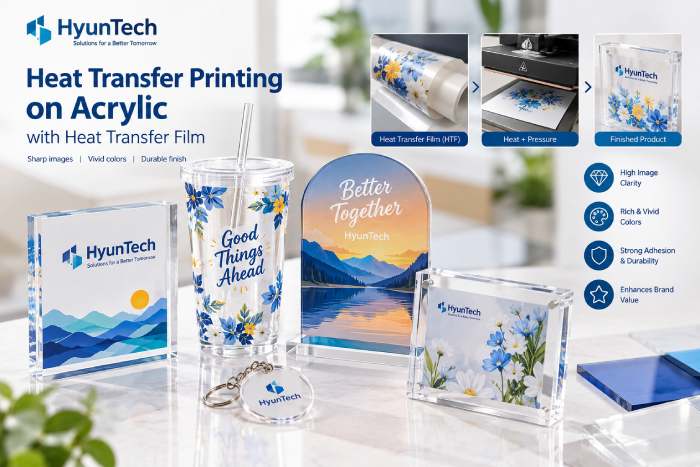
Heat Transfer Printing on Acrylic Using Heat Transfer Film
Read more:
Heat Transfer Printing on Glass | HyunTech
Heat Transfer Printing on Stainless Steel | Hyuntech
Heat Transfer Printing on Aluminum | HyunTech
Heat Transfer Printing on PVC | HyunTech
Heat Transfer Printing on ABS | HyunTech
Heat Transfer Printing on Acrylic | HyunTech
Heat Transfer Printing on Plastic Products | HyunTech
Heat Transfer Printing on Plastic Components | Hyun tech
Heat Transfer Printing on Plastic Boxes | HyunTech
Heat Transfer Printing on Plastic Household Products | HyunTech
Heat Transfer Printing on Household Products | HyunTech
Heat Transfer Printing on Metal Utensils | HyunTech
What Is Acrylic? Is Acrylic the Same as Mica?
Acrylic is the common name for a transparent plastic material based on PMMA – Polymethyl Methacrylate. In Vietnam, this material is commonly referred to as Mica.
Acrylic is known for its transparency, machinability, and aesthetic appearance. Depending on the grade, acrylic can be produced in different colors and surface finishes.
Typical PMMA Properties
| Property | Typical Reference Value |
|---|---|
| Material | PMMA – Polymethyl Methacrylate |
| Density | Approximately 1.18–1.20 g/cm³ |
| Glass Transition Temperature (Tg) | Approximately 105–110°C |
| Thermal Conductivity | Approximately 0.19 W/m·K |
| Coefficient of Thermal Expansion | Approximately 70–80 µm/m·K |
| Transparency | Up to approximately 90% for clear PMMA |
| Product Forms | Sheets, boxes, signs, fabricated components |
These values may vary depending on the material grade, manufacturer, additives, and test method. Reference data for PMMA generally places its glass transition temperature around 105–110°C.
Important: Acrylic does not have one single formulation or one universal heat resistance level. Therefore, the specifications of the actual acrylic product should be confirmed before selecting heat transfer parameters.
What Is Heat Transfer Printing on Acrylic?
Heat Transfer Printing on Acrylic is a process in which a pre-printed transfer film containing the required image is applied to an acrylic surface using suitable heat and pressure.
The basic process includes:
Design → HTF Preparation → Acrylic Surface Cleaning → Alignment → Heat Transfer → Film Peeling → Quality Inspection
Three key factors must be carefully controlled:
- Film type: The film must be compatible with the acrylic surface.
- Transfer parameters: Temperature, time, and pressure.
- Product surface: Clear, colored, glossy, matte, coated, or treated acrylic surfaces may require different approaches.
Acrylic Products Suitable for Heat Transfer Printing
Acrylic can be fabricated into many different product forms. Heat transfer printing can be evaluated for applications such as:
| Acrylic Product | Printing Content | Purpose |
|---|---|---|
| Acrylic Nameplates | Logo, brand name | Branding |
| Acrylic Signs | Logo, text, graphics | Advertising |
| Acrylic Boxes | Logo, images | Packaging, display |
| Product Display Boxes | Patterns, branding | Decoration |
| Display Stands | Logo, information | POSM |
| Acrylic Menus | Text, images | Restaurants, retail |
| Directional Signs | Symbols, text | Offices, stores |
| Promotional Products | Logo, slogan | Marketing |
| Acrylic Gifts | Images, logo | Corporate gifts |
| Decorative Components | Patterns | Interior decoration |
Logo Printing on Acrylic
Logos are one of the most suitable applications for heat transfer printing.
Businesses can apply their logos to:
- Nameplates
- Product boxes
- Display stands
- Promotional products
- Corporate gifts
- Custom-designed acrylic equipment and products
For businesses that require consistent brand identity, transferring the logo directly onto the product can create a more integrated appearance than some conventional sticker-based solutions.
Multi-Color Graphic Printing on Acrylic
In addition to logos, acrylic products can also be decorated with:
- Images
- Decorative patterns
- Graphic patterns
- Slogans
- Symbols
- Multi-color graphic designs
For designs containing many fine details, the resolution of the artwork, acrylic background color, and film structure should be checked before production.
Advantages of Heat Transfer Printing on Acrylic
High Aesthetic Quality
Acrylic already offers an attractive surface appearance, especially clear, colored, and glossy acrylic. When combined with an appropriate graphic design, heat-transfer graphics can become an integrated part of the product design.
Effective Brand Identification
Logos, slogans, and brand colors can be transferred directly onto products, helping strengthen visual brand recognition.
Suitable for Promotional Products
Acrylic is widely used in POSM, signage, display boxes, and promotional products, creating various potential applications for heat transfer printing.
Flexible Customization
Businesses are not limited to a single logo design and can develop different graphics for different product lines.
Acrylic Specifications to Check Before Heat Transfer Printing
This is an important step for minimizing defects during mass production.
| Specification | What Needs to Be Determined |
|---|---|
| Acrylic Type | Cast PMMA, extruded PMMA, or other types |
| Color | Clear, white, black, colored |
| Thickness | Based on the actual product |
| Surface | Glossy, matte, textured |
| Coating | With or without coating |
| Shape | Flat, curved, box-shaped, 3D |
| Printing Area | mm or cm |
| Application Conditions | Indoor/outdoor |
| Abrasion Level | Low/medium/high |
| Durability Requirement | Based on intended application |
Does Acrylic Thickness Affect the Printing Process?
Thickness does not directly determine the adhesion of the film, but it can affect how the product is fixtured, heat transfer behavior, and the risk of deformation for thin components.
For example, a 5 mm acrylic sheet and a thin acrylic component may require different fixturing methods and operating parameters when processed using the same equipment.
Therefore, for industrial products, testing should be conducted using the actual acrylic material and actual product thickness.
What Temperature Is Used for Heat Transfer Printing on Acrylic?
This is an important consideration.
PMMA generally has a glass transition temperature of approximately 105–110°C. However, this does not mean that the heat transfer temperature must be equal to or below a specific fixed value. Actual operating parameters depend on the HTF, acrylic grade, surface condition, and equipment.
Excessive heat or dwell time may affect the shape or surface of acrylic products.
Parameters That Need to Be Tested
| Parameter | What Needs to Be Checked |
|---|---|
| Temperature | Based on the HTF and acrylic |
| Time | Based on the film structure |
| Pressure | Based on product geometry |
| Fixturing Method | Based on product size and thickness |
| Film Peeling Method | Based on film type |
| Adhesion | Check after transfer |
| Image Sharpness | Compare with approved sample |
| Deformation | Inspect before and after transfer |
A temperature setting found online should not simply be applied to every acrylic product.
For clear acrylic or products requiring high dimensional accuracy, temperature and dwell time should be carefully controlled to minimize potential effects on the surface.
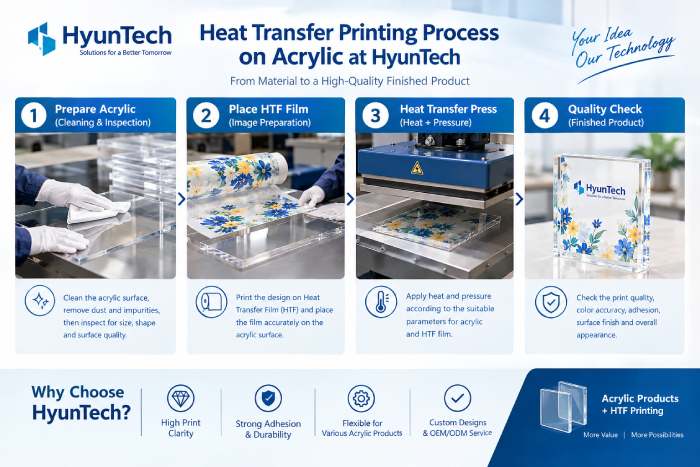
Heat Transfer Printing Process on Acrylic at HyunTech
Sample and Requirement Assessment
Customers should provide:
- Acrylic sample
- Product dimensions
- Material thickness
- Product shape
- Printing position
- Quantity
- Artwork/design file
- Color requirements
- Application conditions
Surface Inspection
Our technical team evaluates:
- Surface flatness
- Gloss level
- Surface texture
- Background color
- Surface coating
- Heat resistance
- Product geometry
HTF Selection
Not every heat transfer film is suitable for every acrylic surface.
Film selection should be based on:
Acrylic → Surface → Design → Transfer Conditions → Durability Requirements
Sample Testing
The transfer sample is evaluated for:
- Adhesion
- Color
- Image sharpness
- Image positioning
- Uniformity
- Deformation
- Abrasion resistance according to application requirements
Parameter Confirmation
Once the sample meets the required specifications, the transfer parameters are recorded and standardized for production.
Mass Production
After the sample is approved, HyunTech proceeds with production according to the agreed quantity and technical requirements.
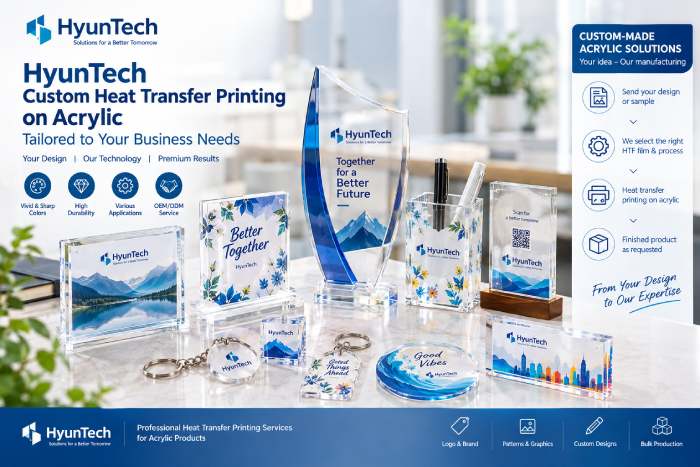
Hyuntech Provides Custom Heat Transfer Printing on Acrylic
Is Heat Transfer Printing on Acrylic Durable?
The answer depends on the film type, acrylic surface, and actual application conditions.
An acrylic product used only for indoor display has completely different requirements from a product that is frequently exposed to handling, water, cleaning agents, or abrasion.
Factors Affecting Durability
| Factor | Impact Level |
|---|---|
| HTF Type | Very High |
| Acrylic Surface | Very High |
| Transfer Parameters | Very High |
| Surface Coating | High |
| Abrasion | High |
| Water Exposure | Product-dependent |
| Chemicals | Application-dependent |
| UV Exposure | Film-dependent |
| Cleaning Method | High |
If the customer requires long-term use or frequent cleaning, the application conditions should be considered from the film selection stage.
Heat Transfer Printing vs. UV Printing on Acrylic
Both UV printing and heat transfer printing can be used to decorate many acrylic products, but their operating principles and production processes are different.
| Criteria | Heat Transfer Printing | UV Printing |
|---|---|---|
| Logo | Good | Good |
| Multi-Color Images | Good | Good |
| Patterns | Good | Good |
| Flat Acrylic | Suitable | Suitable |
| Curved Acrylic | Product-dependent | Equipment-dependent |
| Complex Graphics | Suitable | Suitable |
| Mass Production | Suitable | Suitable |
| Required Equipment | Heat press + film | UV printer |
| Customization | High | High |
The appropriate printing method should be selected based on design, production volume, acrylic geometry, durability requirements, and production cost, rather than simply choosing a technology based on its name.
Reference Pricing for Heat Transfer Printing on Acrylic
The cost of heat transfer printing on acrylic depends on printing area, quantity, product geometry, film type, and technical requirements.
| Service | Reference Pricing |
|---|---|
| Logo Printing on Acrylic | Contact for quotation |
| Multi-Color Graphic Printing | Contact for quotation |
| Acrylic Nameplate Printing | Contact for quotation |
| Acrylic Box Printing | Contact for quotation |
| Display Stand Printing | Contact for quotation |
| Custom-Shaped Acrylic Printing | Contact for quotation |
| Mass Production | Quotation based on quantity |
| HTF Supply | Quotation based on specifications |
| Sample Testing | Contact for quotation |
The pricing above is for reference only and is not a fixed HyunTech price list.
For B2B orders, HyunTech should provide a quotation after receiving information about the acrylic sample, printing area, quantity, artwork, and durability requirements rather than applying a general fixed unit price.
Factors That Determine the Cost of Heat Transfer Printing on Acrylic
Printing Area
A 30 × 30 mm logo has completely different material consumption from a design covering almost the entire acrylic sheet.
Quantity
Large production volumes can help optimize film preparation costs and processing time.
Product Shape
Flat acrylic sheets are generally easier to fixture than boxes, curved components, or 3D products.
Design
Multi-color designs, highly detailed graphics, or designs requiring precise positioning may increase preparation and processing time.
Testing Requirements
If the customer requires adhesion, abrasion, or special application-condition testing, the project cost and lead time may vary.
Common Problems in Heat Transfer Printing on Acrylic
Acrylic Deformation
This may be related to heat, dwell time, or product fixturing.
Uneven Film Adhesion
The acrylic surface, film type, and transfer conditions should be checked.
Blurred Graphics
Potential causes include pressure, dwell time, contact between the film and surface, or artwork preparation.
Misaligned Logo
This is often related to product positioning or film alignment during the transfer process.
Color Does Not Match the Approved Sample
The acrylic background color, artwork, film structure, and transfer conditions should be checked.
Press Marks on Acrylic
These may be related to heat, pressure, protective layers, or how the product is positioned during transfer.
For these issues, the most effective approach is to test the actual product sample first rather than making large-scale adjustments directly on the production line.
HyunTech – Heat Transfer Film Solutions and Acrylic Printing Services
HyunTech develops Heat Transfer Film (HTF) solutions and heat transfer printing services for various industrial material groups. The HyunTech website introduces heat transfer film applications for materials including PET, ABS, PP, HDPE, metal, glass, and wood.
For acrylic products, the appropriate solution should be determined based on the actual product sample and intended application conditions.
What Types of Orders Does HyunTech Support?
- Acrylic product manufacturers
- Nameplate and signage manufacturers
- POSM suppliers
- Acrylic box manufacturers
- Promotional product manufacturers
- Corporate gift manufacturers
- Businesses requiring logo printing on Mica
- Factories requiring HTF
- Businesses requiring high-volume heat transfer printing services
Submit Your Acrylic Sample – Get Consultation and a Quotation from HyunTech
Are you looking for heat transfer printing on acrylic, logo printing on Mica, graphic printing on acrylic signs, or a suitable Heat Transfer Film for acrylic?
Send your product sample to HyunTech for direct evaluation.
The following information is recommended:
Acrylic sample or product images
Material thickness
Printing area dimensions
Expected quantity
Logo/artwork file
Required colors
Application conditions
Durability requirements
HyunTech can support the following process:
Sample Assessment → Surface Evaluation → Film Selection → Sample Testing → Parameter Confirmation → Quotation → Production
This approach is more appropriate than selecting a film or transfer parameter solely based on general information available online.
HyunTech Holdings
- Hotline: 0332 837 260 – 088.881.3333
- Email: contact@hyuntech.com.vn
- Office: Lot BT11, Eurowindow River Park Urban Area, Dong Hoi, Dong Anh, Hanoi, Vietnam
- Factory: 312 Nguyen Van Linh, Hung Yen, Vietnam
- Heat Transfer Processing Workshop: Doai Village, Tam Xa, Dong Anh, Hanoi, Vietnam
- Website: HyunTech.com.vn
Need heat transfer printing on acrylic/Mica? Send your sample to HyunTech for film consultation, practical testing, and a product-specific quotation.
Frequently Asked Questions About Heat Transfer Printing on Acrylic
What is heat transfer printing on acrylic?
Heat transfer printing on acrylic is a method that uses Heat Transfer Film, heat, and pressure to transfer logos, images, text, or graphics onto acrylic/Mica surfaces.
Can acrylic be heat transfer printed?
It can be evaluated and processed depending on the acrylic type, surface condition, coating, product geometry, and film type. For actual production products, sample testing is recommended before mass production.
What temperature is used for heat transfer printing on acrylic?
There is no single fixed temperature for all acrylic products. PMMA typically has a glass transition temperature of approximately 105–110°C, but this is not the heat transfer printing temperature. Temperature, time, and pressure must be determined according to the HTF and the actual product.
Is heat transfer printing on acrylic durable?
Durability depends on the film type, acrylic surface, transfer parameters, and application conditions. If the product is frequently exposed to abrasion, water, chemicals, or sunlight, the film should be selected and tested according to the actual operating environment.
Does HyunTech provide custom heat transfer printing on acrylic?
HyunTech provides Heat Transfer Film solutions and custom heat transfer printing services. Customers can submit acrylic samples, artwork files, printing dimensions, and expected quantities for evaluation and solution recommendations.