Heat Transfer Printing on Metal Tools
Heat transfer printing on metal tools is a decorative and product branding method used for a wide range of aluminum, steel, stainless steel, and other metal surfaces with suitable surface treatments.
Logos, brand names, symbols, patterns, and images can be transferred onto product surfaces using heat transfer film combined with controlled temperature, pressure, and transfer time.
Unlike simply selecting an ink or film based on the material name, printing performance depends on multiple factors, including metal type, surface coating, surface roughness, product geometry, film structure, fixtures, and transfer equipment.
For industrial production, sample testing before mass production is particularly important. It allows manufacturers to evaluate print adhesion, color, sharpness, and consistency before scaling up production.
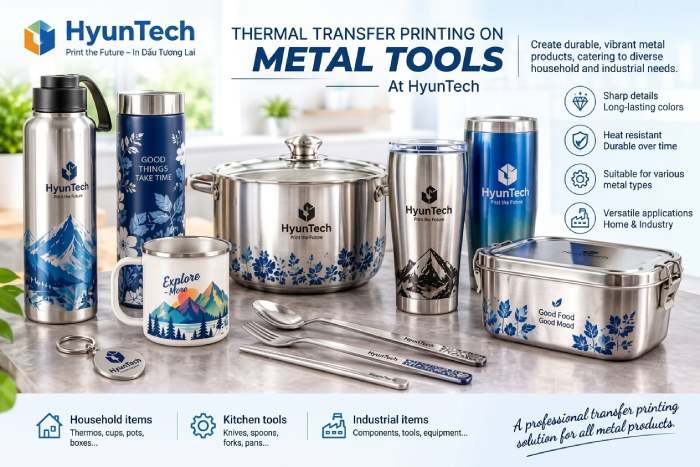
Metal tools printed with logos, patterns, and symbols using heat transfer printing technology, suitable for household and industrial manufacturing applications.
Read more: What Is Heat Transfer Printing?
What Is Heat Transfer Printing on Metal Tools?
Heat transfer printing on metal is a process that uses heat transfer film containing images or a specially designed ink layer to transfer graphics onto the product surface through controlled heat and pressure.
Depending on the product structure, heat transfer printing can be considered for:
- Metal kitchenware.
- Metal bottles, containers, and boxes.
- Hand tools.
- Equipment housings and components.
- Machine components.
- Promotional and branded products.
- Metal accessories.
- OEM products.
- Aluminum, steel, or stainless steel components with suitable surfaces.
It is important to distinguish heat transfer printing on metal from sublimation printing on polymer-coated aluminum. Sublimation typically requires a suitable polymer coating on the metal surface so that the dye can bond with the coating, while industrial heat transfer film systems use different structures and must be selected according to the material, surface condition, and product requirements.
What Metal Tools Can Be Heat Transfer Printed?
Printability depends on the actual surface condition, but the following product categories are commonly considered for heat transfer printing:
| Product Category | Common Materials | Typical Printing Applications |
|---|---|---|
| Kitchen Tools | Stainless steel, aluminum, steel | Logos, branding |
| Metal Bottles | Stainless steel, aluminum | Logos, decorative patterns |
| Metal Boxes | Tinplate, steel, aluminum | Images, brand identification |
| Hand Tools | Steel, stainless steel | Logos, symbols |
| Equipment Housings | Aluminum, steel | Logos, technical information |
| Machine Components | Steel, aluminum | Codes, identification marks |
| Metal Accessories | Aluminum, steel, stainless steel | Logos, patterns |
| Metal Promotional Products | Aluminum, steel, stainless steel | Logos, images |
Aluminum
Aluminum is lightweight and widely used in household products, industrial components, and promotional products.
However, different aluminum surfaces can produce different printing results. Bare aluminum, anodized aluminum, painted aluminum, and differently treated aluminum surfaces may each require a different printing approach.
Stainless Steel
Stainless steel is commonly used for water bottles, kitchenware, household products, and many industrial applications.
For stainless steel products, the surface condition should be identified before selecting the appropriate transfer film. Common finishes include mirror-polished, brushed, matte, painted, and otherwise surface-treated finishes.
Steel
Steel is widely used for tools, equipment, and industrial components.
If the product has a protective paint or coating, print adhesion can depend significantly on this surface layer rather than on the underlying steel itself.
Technical Specifications to Determine Before Printing
To achieve stable heat transfer printing on metal tools, manufacturers should define the key input specifications before sample development.
| Parameter | Reference Example | Impact |
|---|---|---|
| Material | Aluminum, stainless steel, steel | Determines the transfer film approach |
| Printing Area Width | 30–150 mm | Determines graphic dimensions |
| Printing Area Height | 20–100 mm | Affects artwork layout |
| Number of Colors | 1–6 colors or more | Depends on the design |
| Surface | Flat / curved / cylindrical | Affects fixture requirements |
| Cylindrical Product Diameter | 30–100 mm | Affects artwork positioning |
| Production Volume | 1,000–100,000+ products | Affects production planning |
| Printing Positions | 1 or multiple positions | Affects processing time |
| Durability Requirements | Based on intended application | Determines testing criteria |
The ranges above are reference values for establishing initial requirements. Actual production parameters must be confirmed through sample testing.
How Does Print Area Affect Heat Transfer Film Consumption?
Print area is one of the key parameters when calculating material requirements.
For example, a metal tool has a printing area of:
80 × 40 mm
The print area is:
80 × 40 = 3,200 mm² = 32 cm²
For an order of 20,000 products:
32 × 20,000 = 640,000 cm² = 64 m²
This represents only the theoretical printed area.
The actual amount of heat transfer film required will be higher because manufacturers must also account for:
- Spacing between graphics.
- Margins.
- Cutting waste.
- Artwork layout on the film.
- Testing-related waste.
- Film roll specifications.
- Product fixturing requirements.
Calculating these factors in advance helps manufacturers better control film consumption and cost per unit.
What Temperature Is Required for Heat Transfer Printing on Metal?
A single fixed temperature should not be applied to every metal tool.
Transfer temperature, time, and pressure depend on:
- Film structure.
- Ink type.
- Metal material.
- Metal surface coating.
- Surface roughness.
- Product geometry.
- Fixtures.
- Equipment.
- Production speed.
- Adhesion requirements.
For example, a polished stainless steel tool and a painted steel tool may require two different treatment and transfer approaches, even though both are generally classified as “metal tools.”
Some heat-based metal printing methods on the market use heat and pressure to transfer images. Metal sublimation, on the other hand, typically requires a suitable polymer coating on the metal surface.
Therefore, HyunTech does not recommend taking a temperature setting found online and applying it directly to a mass-production process.
Final production parameters should be established through sample testing on the actual product.
Heat Transfer Printing Process for Metal Tools at HyunTech
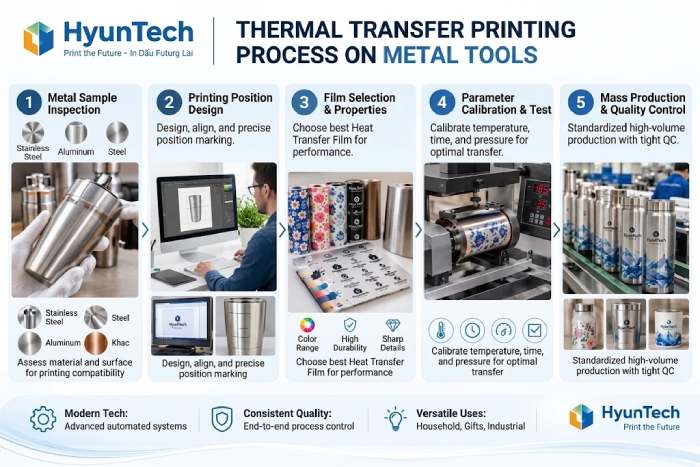
Product Inspection
HyunTech evaluates key product characteristics, including:
- What type of metal is used?
- Is the surface untreated or coated?
- Is the product flat or curved?
- What is the printing area?
- Are there edges, corners, or components that may interfere with printing?
- What is the required production volume?
Artwork Review
The artwork file is reviewed for:
- Dimensions.
- Proportions.
- Colors.
- Fine details.
- Logo positioning.
- Safe distance from product edges.
Transfer Film Selection
The transfer film is selected according to the actual material and surface condition, rather than simply based on the general term “heat transfer film.”
Sample Testing
Sample testing is used to evaluate:
- Print adhesion.
- Print sharpness.
- Color appearance.
- Image transfer performance.
- Print consistency.
- Image transfer on curved surfaces.
- Resistance under the required usage conditions.
Parameter Confirmation and Production
Once the sample meets the required specifications, the production parameters can be established and controlled to minimize variation between production cycles.
Factors Affecting Print Adhesion on Metal
Print adhesion does not depend on temperature alone.
The process can be viewed as a complete chain:
Film → Metal Surface → Heat → Pressure → Time → Cooling → End-Use Conditions
If one element is unsuitable, the final printing result may change.
| Factor | Potential Issue |
|---|---|
| Oil or Dust on Surface | Uneven print adhesion |
| Incompatible Film | Peeling or incomplete transfer |
| Uneven Pressure | Part of the image may not transfer |
| Unstable Fixture | Logo misalignment |
| Unsuitable Temperature | Incomplete image transfer |
| Excessive Temperature | May affect the coating or product |
| Unsuitable Transfer Time | Unstable adhesion and image quality |
| Excessive Surface Curvature | Graphic distortion |
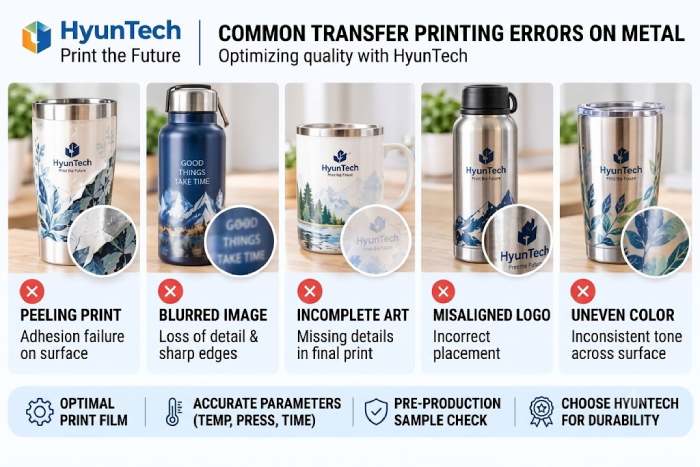
Common Errors in Thermal Transfer Printing on Metal Utensils
Heat Transfer Printing vs. UV Printing on Metal Tools
These two technologies have different application characteristics.
| Criteria | Heat Transfer Printing | UV Printing |
|---|---|---|
| Printing Method | Transfers graphics from a film | Prints directly onto the surface |
| Fixturing | May be required depending on the product | Product must be securely positioned |
| Curved Surfaces | Can be implemented with suitable process and fixture design | Depends on machine capability and print-head distance |
| OEM Products | Suitable for a wide range of requirements | Suitable for a wide range of designs |
| High-Volume Production | Can be optimized when the process is stable | Depends on equipment configuration |
| Color | Depends on film structure | Depends on the ink system |
| Cost | Depends on film, fixtures, and production volume | Depends on machine, ink, and printing time |
The printing technology should not be selected based solely on initial cost. For industrial production, manufacturers should consider material, product geometry, production volume, aesthetic requirements, durability, and production speed.
Heat Transfer Printing Price for Metal Tools
Actual costs depend heavily on the product sample and production volume. HyunTech therefore provides quotations based on individual requirements rather than applying one standard price.
| Service Item | Pricing Basis | Quotation |
|---|---|---|
| Sample Testing | Product and testing requirements | Contact us |
| Heat Transfer Film | Film type + dimensions + volume | Contact us |
| Single-Color Logo Printing | Print area + quantity | Sample-based quotation |
| Multi-Color Logo Printing | Artwork + film structure | Sample-based quotation |
| Curved Surface Printing | Product geometry + fixtures | Project-based quotation |
| High-Volume Production | Volume + technical requirements | Volume-based quotation |
| OEM Orders | Specific standards and production volume | Contact us |
Note: This is a reference service pricing structure, not a fixed price list. For an accurate quotation, manufacturers should provide the product sample, material, printing area dimensions, artwork file, and expected production volume.
Factors That Determine Metal Product Printing Costs
Print Area
Larger graphics generally require more transfer film and may increase processing time.
Production Volume
Large orders can help optimize preparation, fixture, and production costs per unit.
Number of Colors and Design Complexity
Simple logos and highly detailed designs may require different film structures and processing methods.
Product Geometry
Flat products are generally easier to fixture than cylindrical, curved, or multi-angle products.
Metal Surface
Bare aluminum, polished stainless steel, brushed stainless steel, painted steel, and other coated metal surfaces should be evaluated separately.
Durability Requirements
If the product is frequently exposed to water, friction, cleaning agents, heat, or outdoor environments, the required testing criteria should be established at the beginning of the project.
HyunTech – Heat Transfer Film and Printing Solutions for Metal Products
HyunTech supplies heat transfer films and custom heat transfer printing services for industrial applications, including metal products and components.
Rather than simply supplying a standard film, HyunTech evaluates the complete printing process:
Product → Material → Surface → Artwork → Film → Parameters → Testing → Production
This approach is particularly important for OEM manufacturers and high-volume production facilities because achieving a good-looking prototype does not automatically guarantee stable printing across thousands of products.
What Information Should Manufacturers Send to HyunTech?
To receive faster technical consultation and a more accurate quotation, manufacturers should provide:
- Product photos.
- Product samples, if available.
- Metal material.
- Surface condition.
- Product dimensions.
- Printing area dimensions.
- Logo or artwork file.
- Expected production volume.
- Color requirements.
- Durability requirements.
- Photos or videos of the current production process if another printing method is already being used.
HyunTech can use this information to evaluate printability, film selection, testing requirements, and production-based pricing.
Frequently Asked Questions About Heat Transfer Printing on Metal Tools
Can Heat Transfer Printing Be Used on Stainless Steel?
Stainless steel can be considered for heat transfer printing, but the specific approach depends on the surface condition, such as polished, brushed, matte, or coated stainless steel. Direct testing on the actual product is recommended before mass production.
Is Heat Transfer Printing on Aluminum Durable?
Durability depends on the aluminum type, surface treatment, transfer film, transfer parameters, and actual usage conditions. A single durability rating should not be assumed for every aluminum product.
What Temperature Is Used for Heat Transfer Printing on Metal?
There is no universal temperature for every metal tool. Temperature, transfer time, and pressure should be determined based on the film, surface, material, equipment, and sample test results.
Can Multi-Color Logos Be Printed on Metal Tools?
Yes. Heat transfer film can be designed according to the required logo, image, and colors. For multi-color artwork or fine details, sample testing is recommended to verify sharpness and color reproduction on the actual surface.
Does HyunTech Provide Heat Transfer Film and Printing Services for Metal?
Yes. HyunTech supplies heat transfer films and provides custom heat transfer printing services. Manufacturers can submit product samples or product information so that HyunTech can evaluate the most suitable printing solution before production.
Send Your Metal Tool Sample to HyunTech for Consultation
If your company is looking for heat transfer printing on metal tools, send your product sample or product photos to HyunTech for evaluation.
HyunTech evaluates the material, surface, artwork, printing area, production volume, and durability requirements to recommend a suitable printing solution rather than applying one standard configuration to every product.
HyunTech – Heat Transfer Films & Industrial Printing Solutions
Hotline: 0332 837 260 – 088.881.3333
Email: contact@hyuntech.com.vn
Office: Lot BT11, Eurowindow River Park Urban Area, Dong Hoi, Dong Anh, Hanoi, Vietnam
Factory: 312 Nguyen Van Linh, Hung Yen, Vietnam
Do you have metal products that need logos, branding, symbols, or decorative graphics? Send your sample to HyunTech for printing consultation, sample testing, and a production-based quotation.