
Heat Transfer Printing on Plastic Products | HyunTech
Heat Transfer Printing on Plastic Products is a surface decoration solution used to apply logos, images, text, patterns, and brand identification onto a wide range of plastic products.
From plastic bottles, cups, boxes, caps, trays, and containers to equipment housings, plastic components, and household products, Heat Transfer Film (HTF) enables manufacturers to create customized graphics directly on their products.
The key consideration when printing on plastic is that different plastics have different surface characteristics and heat resistance. PP, PE, PET, ABS, PVC, PS, and coated plastics cannot automatically use the same film or transfer parameters.
HyunTech provides Heat Transfer Film for plastic products and custom heat transfer printing services. Materials such as PET, ABS, PP, and HDPE are among the material groups for which HTF applications can be evaluated.
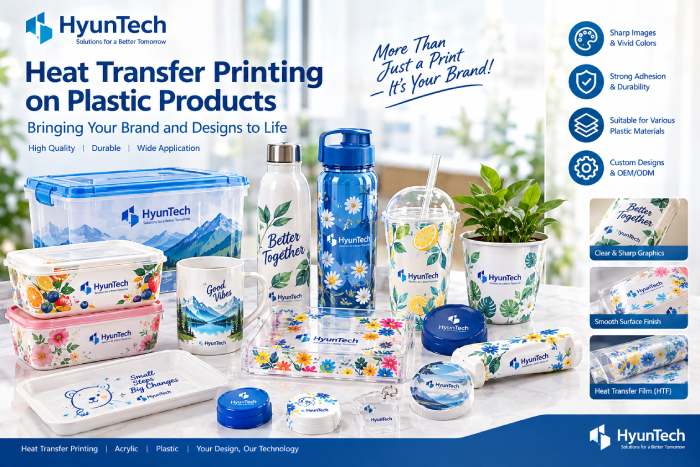
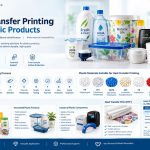
Heat transfer printing on plastic products using Heat Transfer Film
Read more: Heat Transfer Printing for Plastic Products | Hdecal
What Is Heat Transfer Printing on Plastic Products?
Heat Transfer Printing on Plastic Products is a process that uses a pre-printed transfer film and transfers the graphic layer onto the surface of a plastic product using appropriate heat and pressure.
The basic process can be described as:
Design → Print Graphic onto HTF → Position Film on Product → Heat Transfer → Film Peeling → Quality Inspection
Unlike applying a conventional sticker, the graphic is transferred directly onto the designated product surface.
This technology can be considered for manufacturers that need:
- Brand logo printing
- Product graphic printing
- Decorative pattern printing
- Pattern and graphic applications
- Text and slogan printing
- Identification symbols
- Customized plastic product decoration
What Types of Plastic Can Be Used for Heat Transfer Printing?
Not all plastics have the same heat transfer characteristics. Film selection should be based on the plastic type, surface condition, and intended application.
| Plastic Type | Full Name | Common Applications | HTF Application |
|---|---|---|---|
| PP | Polypropylene | Boxes, cups, trays, packaging | Possible |
| PE | Polyethylene | Bottles, containers, drums | Possible, surface-dependent |
| PET | Polyethylene Terephthalate | Bottles, boxes, packaging | Possible |
| ABS | Acrylonitrile Butadiene Styrene | Equipment housings, components | Possible |
| PVC | Polyvinyl Chloride | Components, plastic products | Type-dependent |
| PS | Polystyrene | Boxes, trays, household products | Product-dependent |
| Acrylic/PMMA | Polymethyl Methacrylate | Signs, boxes, decorative products | Requires testing |
| HDPE | High-Density Polyethylene | Containers, bottles, drums | Possible, surface-dependent |
Important: The table above indicates potential HTF applications for different plastic groups. Actual production should be preceded by testing the film on the specific plastic material and surface.
What Plastic Products Can Be Heat Transfer Printed?
The application range is extensive.
| Plastic Product | Printing Content | Purpose |
|---|---|---|
| Plastic Bottles | Logo, graphics | Branding |
| Plastic Cups | Logo, patterns | Promotional, commercial |
| Plastic Boxes | Logo, patterns | Packaging |
| Plastic Caps | Logo, symbols | Identification |
| Plastic Trays | Logo, information | Commercial |
| Plastic Containers | Logo, identification codes | Industrial |
| Equipment Housings | Logo, text | Electrical & electronics |
| Plastic Components | Symbols, codes | Industrial |
| Household Plastic Products | Logo, patterns | Decoration |
| Plastic Toys | Graphics | Decoration |
| Promotional Products | Logo, slogan | Marketing |
| Plastic Accessories | Logo, patterns | Branding |
Logo Printing on Plastic Bottles
Plastic bottles are among the product groups with significant surface-decoration requirements.
Logos can be customized according to brand colors and dimensions, depending on the plastic material and surface structure.
Potential applications include:
- PET bottles
- Household plastic bottles
- Cosmetic bottles
- Personal-care product bottles
- Product containers
- Plastic jars and bottles
- Water and beverage bottles where the product and application are suitable
For bottles with curved surfaces, the fixturing and film-transfer method should be tested to minimize wrinkles or graphic distortion.
Heat Transfer Printing on Plastic Boxes
Plastic boxes are widely used in packaging, food-related products, household goods, electronics, and other manufacturing industries.
Logos or graphics can be positioned on:
- Front panels
- Side panels
- Lids
- Brand identification areas
- Product instruction areas
For boxes with multiple corners or complex geometry, the printing area and contact conditions of the heat press should be evaluated before selecting the transfer method.
Heat Transfer Printing on Plastic Cups
Plastic cups can be used as promotional products, branded merchandise, or consumer products.
For cylindrical or tapered cups, film alignment and pressing methods need to be designed according to the actual product geometry.
Technical Specifications to Check Before Printing Plastic Products
A common mistake is to simply identify a product as “plastic” without determining the exact material.
Before printing, manufacturers should identify:
| Specification | What Needs to Be Checked |
|---|---|
| Plastic Type | PP, PE, PET, ABS, PVC, PS, etc. |
| Background Color | White, black, clear, colored |
| Surface | Glossy, matte, textured |
| Coating | With or without coating |
| Product Shape | Flat, curved, cylindrical, box-shaped |
| Printing Area | mm or cm |
| Thickness | Based on actual product |
| Operating Temperature | Based on actual environment |
| Abrasion | Low, medium, high |
| Chemical Exposure | With or without chemical contact |
| Outdoor Use | Yes/no |
| Durability Requirement | Based on intended application |
Why Is It Important to Identify the Exact Plastic Type?
For example, PP and ABS are both plastics, but their surface properties and thermal characteristics are different.
Therefore, a heat transfer film developed for ABS should not automatically be used on PP or PE without testing.
This is also why providing HyunTech with an actual product sample is often more useful than providing only the product name.
What Temperature Is Used for Heat Transfer Printing on Plastic?
There is no single transfer temperature suitable for all plastic products.
Transfer parameters depend on:
- Plastic type
- HTF type
- Plastic surface
- Product thickness
- Product geometry
- Heat press equipment
- Pressure
- Dwell time
- Required durability
It is particularly important to distinguish the heat transfer temperature from the heat resistance or processing temperature of the plastic material.
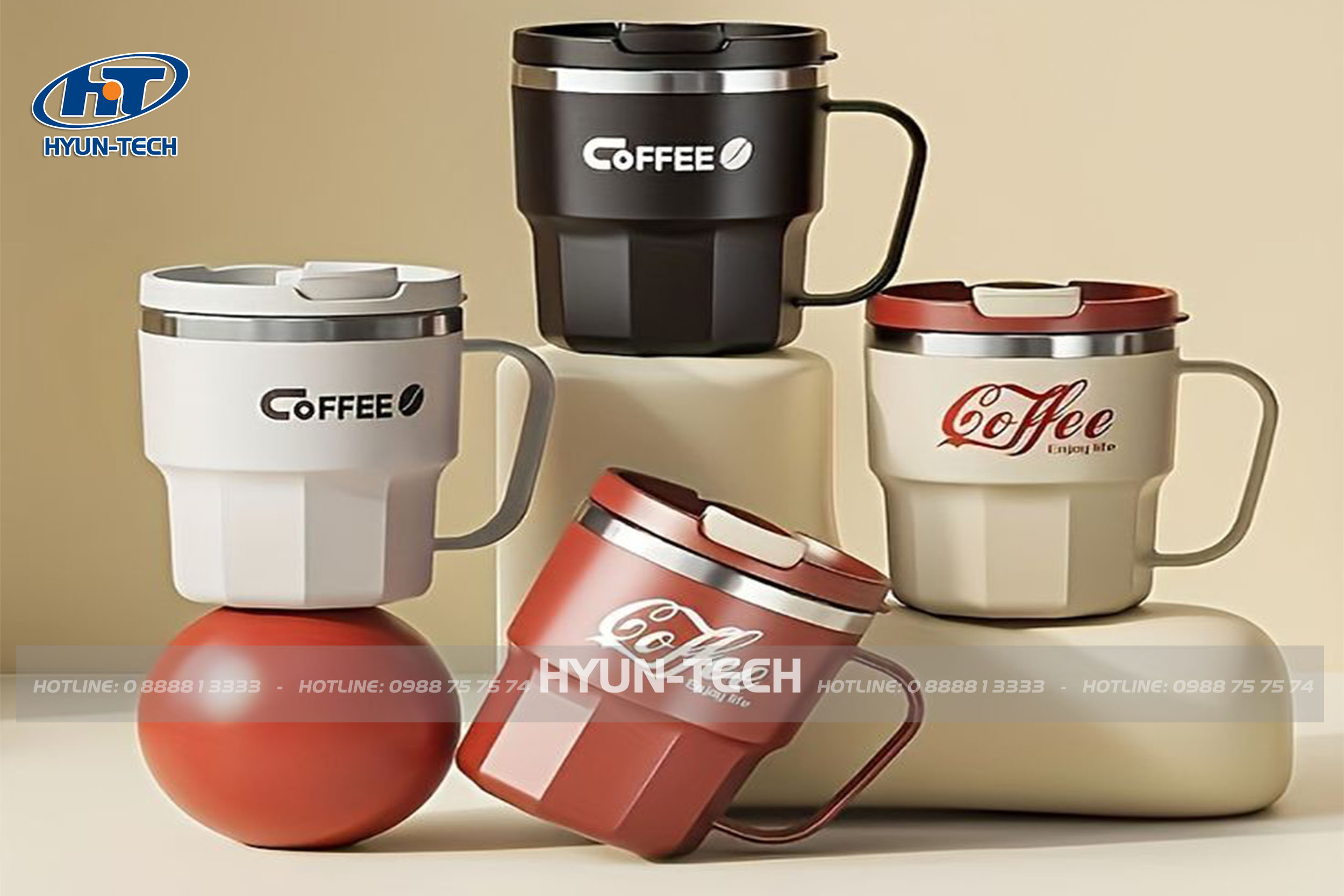
Logo Heat Transfer Printing on Plastic Products
Parameters That Should Be Determined Through Testing
| Parameter | How It Is Determined |
|---|---|
| Transfer Temperature | Based on film + plastic material |
| Transfer Time | Based on film structure |
| Pressure | Based on product |
| Fixturing | Based on product geometry |
| Film Peeling Method | Based on HTF type |
| Adhesion | Checked after transfer |
| Image Sharpness | Compared with approved sample |
| Durability | Based on application conditions |
A fixed temperature found online should not be applied to every plastic product.
For plastic products that are susceptible to deformation, particularly thin components, heat and dwell time should be carefully controlled.
Heat Transfer Printing Process for Plastic Products
Product Sample Inspection
HyunTech evaluates the actual product to determine:
- Plastic type
- Dimensions
- Product geometry
- Surface condition
- Printing area
- Production quantity
- Application conditions
Surface Preparation
The product surface should be clean and suitable for the selected heat transfer method.
Oil, dust, or other contaminants may affect the final transfer result.
HTF Preparation
The artwork is prepared according to the actual printing dimensions and transferred onto the appropriate film.
For plastic products containing multiple colors or complex graphics, the background color should be considered when selecting the film structure.
Film Alignment
The film is accurately positioned over the designated printing area.
For bottles, cups, or curved products, proper product fixturing is particularly important.
Heat Transfer
The film is transferred using appropriate heat and pressure for the selected plastic and HTF.
These parameters should be established through actual testing.
Post-Printing Inspection
The finished products can be checked for:
- Graphic position
- Color
- Image sharpness
- Adhesion
- Uniformity
- Deformation
- Edge lifting
- Abrasion resistance according to requirements
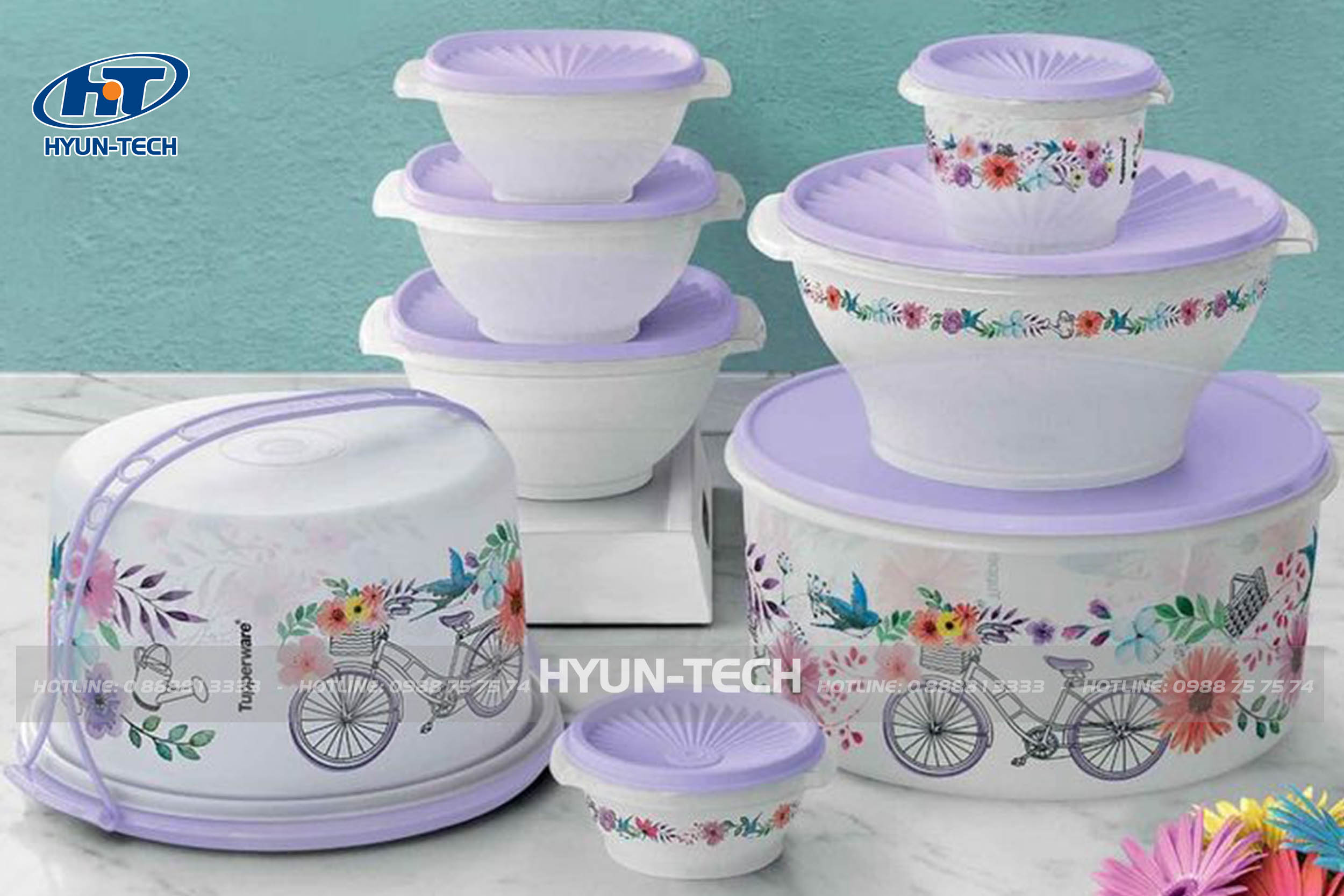
Heat Transfer Printing on Plastic Food Containers
Is Heat Transfer Printing on Plastic Products Durable?
Durability depends on:
HTF + Plastic Type + Surface + Transfer Parameters + Application Conditions
A product used only for display has different durability requirements from a product that is:
- Frequently handled
- Exposed to water
- Frequently washed
- Exposed to oil
- Exposed to chemicals
- Subjected to abrasion
- Used outdoors
Factors Affecting Durability
| Factor | Impact |
|---|---|
| Film Type | Very High |
| Plastic Surface | Very High |
| Transfer Parameters | Very High |
| Surface Coating | High |
| Abrasion | High |
| Chemicals | Application-dependent |
| Water | Application-dependent |
| Sunlight | Film-dependent |
| Cleaning Method | High |
If a product requires high durability, its actual operating conditions should be considered when selecting the film.
Advantages of Heat Transfer Printing on Plastic Products
Wide Range of Graphics and Colors
Logos, text, images, decorative graphics, and patterns can be produced according to the required design.
Suitable for Brand Identification
Brand logos can be applied directly to plastic products instead of relying on separate labels or stickers.
Applicable to Multiple Product Categories
From bottles, boxes, and cups to equipment housings and plastic components, HTF can be evaluated for a wide range of products.
Suitable for Mass Production
Once the sample and transfer parameters have been approved, the process can be standardized for production.
Flexible Product Customization
Manufacturers can use different designs for different products, models, product lines, or marketing campaigns.
Heat Transfer Printing vs. UV Printing on Plastic
| Criteria | Heat Transfer Printing | UV Printing |
|---|---|---|
| Logo | Good | Good |
| Multi-Color Graphics | Good | Good |
| Patterns | Good | Good |
| Flat Products | Suitable | Suitable |
| Curved Products | Product-dependent | Equipment-dependent |
| Plastic Bottles/Cups | Can be evaluated | Equipment-dependent |
| Mass Production | Suitable | Suitable |
| Fixturing Requirements | Yes | Yes |
| Customization | High | High |
The appropriate technology should be selected based on plastic type, product geometry, production volume, design, and durability requirements, rather than simply comparing the unit price.
Reference Pricing for Heat Transfer Printing on Plastic Products
There is no single fixed price for heat transfer printing on plastic products.
Costs generally depend on the plastic type, printing area, quantity, product geometry, and technical requirements.
| Service | Reference Pricing |
|---|---|
| Logo Printing on Plastic Products | Contact for quotation |
| Plastic Bottle Printing | Contact for quotation |
| Plastic Cup Printing | Contact for quotation |
| Plastic Box Printing | Contact for quotation |
| Plastic Cap Printing | Contact for quotation |
| Plastic Component Printing | Contact for quotation |
| Plastic Equipment Housing Printing | Contact for quotation |
| Curved Plastic Product Printing | Contact for quotation |
| Mass Production | Quotation based on quantity |
| HTF Supply | Quotation based on specifications |
| Sample Testing | Contact for quotation |
The table above is for reference classification only and is not a fixed HyunTech price list.
For an accurate quotation, at minimum HyunTech needs the product sample, printing area, quantity, artwork, and plastic type.
Factors That Determine the Cost of Plastic Product Printing
Plastic Type
Different materials may require different film types and surface treatment approaches.
Printing Area
Larger printing areas can increase material consumption and processing time.
Production Quantity
Large-volume orders may help optimize film preparation and production costs.
Product Geometry
Flat products are generally easier to fixture than bottles, cups, caps, or components with multiple edges.
Graphic Complexity
A simple logo is different from a multi-color image or a large-area repeating pattern.
Durability Requirements
Products exposed to abrasion, water, or chemicals may require a different film and testing process from products intended only for display.
Common Problems When Heat Transfer Printing on Plastic
Poor Film Adhesion
Potential causes include plastic type, surface condition, coating, or incorrect film selection.
Plastic Deformation
This may result from unsuitable temperature, dwell time, or pressure.
Blurred Graphics
The film, artwork, pressure, and contact conditions should be checked.
Misaligned Logo
This is often related to product fixturing and film alignment.
Inconsistent Color
Potential causes include product background color, artwork, or film structure.
Edge Lifting
Film adhesion, surface condition, and transfer parameters should be reviewed.
For new products, the safest approach is to test several samples before starting mass production.
HyunTech – Heat Transfer Film Solutions for Plastic Products
HyunTech develops Heat Transfer Film solutions for various plastic material groups, including materials such as PET, ABS, PP, and HDPE.
This provides manufacturers with a basis for evaluating surface-decoration solutions across different plastic product categories.
What Types of Businesses Can Work with HyunTech?
- Plastic bottle manufacturers
- Plastic cup manufacturers
- Plastic box manufacturers
- Plastic component manufacturers
- Electrical and electronics manufacturers
- Household product manufacturers
- Promotional product manufacturers
- Packaging manufacturers
- Businesses requiring logo printing on plastic products
- Factories requiring HTF for production
- Businesses requiring high-volume heat transfer printing
Submit Your Plastic Product Sample – Get Consultation and a Quotation from HyunTech
Are you looking for heat transfer printing on plastic products, logo printing on plastic bottles, cups, boxes, components, or equipment housings?
Send your actual product sample to HyunTech.
Recommended information includes:
Product sample or detailed product images
Plastic type, if known
Printing area dimensions
Expected production quantity
Logo/artwork file
Required colors
Application conditions
Durability requirements
HyunTech can support the following process:
Sample Evaluation → Material Identification → Film Selection → Testing → Adhesion Inspection → Solution Confirmation → Quotation → Production
Testing directly on the actual product helps reduce risks when moving from sample production to mass production.
HyunTech Holdings
- Hotline: +84 332 837 260 – +84 88 881 3333
- Email: contact@hyuntech.com.vn
- Office: Lot BT11, Eurowindow River Park Urban Area, Dong Hoi, Dong Anh, Hanoi, Vietnam
- Factory: 312 Nguyen Van Linh, Hung Yen, Vietnam
- Heat Transfer Processing Workshop: Doai Village, Tam Xa, Dong Anh, Hanoi, Vietnam
- Website: hyuntech.com.vn
Need to print logos, graphics, or patterns on plastic products? Send your sample to HyunTech for HTF consultation, practical testing, and a product-specific quotation.
Frequently Asked Questions About Heat Transfer Printing on Plastic Products
What is heat transfer printing on plastic products?
It is a process that uses Heat Transfer Film, heat, and pressure to transfer logos, text, images, or patterns onto the surface of plastic products.
What types of plastic can be heat transfer printed?
Potential HTF applications include PP, PE, PET, ABS, HDPE, and other plastic materials. Transfer performance and adhesion depend on the specific plastic, surface condition, and film used.
Can heat transfer printing be applied to plastic bottles and cups?
It can be evaluated and implemented depending on the product structure. For curved bottles or cups, product fixturing, printing area, and film compatibility should be tested before mass production.
What temperature is used for heat transfer printing on plastic?
There is no fixed temperature for all plastic products. Temperature, dwell time, and pressure must be determined according to the plastic type, HTF, surface condition, and equipment through practical testing.
Does HyunTech supply HTF and provide heat transfer printing for plastic products?
Yes. HyunTech provides Heat Transfer Film solutions for various plastic materials and supports consultation, testing, and custom heat transfer printing. Customers should provide a product sample, artwork, quantity, and durability requirements for an appropriate solution.
Bài viết cùng chủ đề
-
 Heat Transfer Printing on Metal Tools
-
 Innovative Dairy Packaging Solutions for Milk & Yogurt Brands
-
 “Phù phép” cho sản phẩm kinh doanh cùng công nghệ in chai nước hoa tân tiến hàng đầu
-
 Heat Transfer Printing for Plastic Products | Hdecal
-
 In cốc quà tặng: Món quà ý nghĩa nhất năm nay
-
 Plastic Packaging Printing Methods: Full Guide