Heat Transfer Printing on Household Products
Heat transfer printing on household products is a decorative and branding solution used for a wide range of products, including plastic boxes, cups, bottles, trays, kitchenware, equipment housings, metal household items, glass products, and plastic components.
Instead of using separate decals or adhesive labels, heat transfer printing uses a printed transfer film containing images, logos, or patterns and transfers the design onto the product surface through heat, pressure, and suitable fixtures or equipment.
For household product manufacturers, achieving an attractive print is only one part of the process. The printing solution must also meet requirements for adhesion, print sharpness, high-volume production, batch-to-batch consistency, and compatibility with the substrate material.
HyunTech currently supplies heat transfer films and provides heat transfer printing services for a wide range of products, including household products and plastic industrial applications.
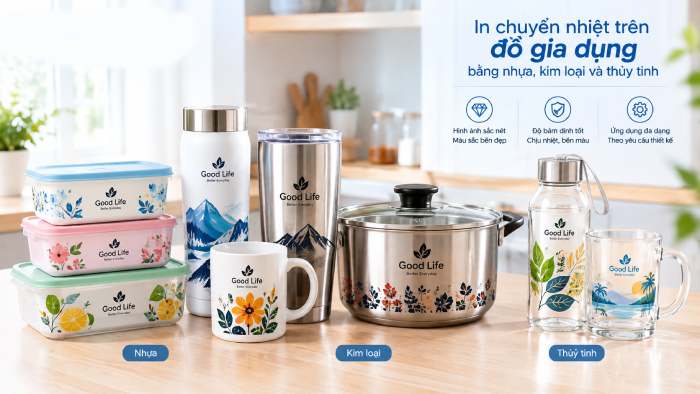
Heat Transfer Printing on Plastic, Metal, and Glass Household Products
Read more: What Is Heat Transfer Printing?
What Is Heat Transfer Printing on Household Products?
Heat transfer printing is a process that uses a pre-printed heat transfer film to transfer an ink layer onto the surface of a product through controlled heat and pressure.
Depending on the product, transfer film, and substrate material, the printing process can be adjusted based on:
- Heat transfer film type.
- Ink type and ink-layer structure.
- Transfer temperature.
- Pressing/transfer time.
- Pressure.
- Machine speed.
- Mold or positioning fixture.
- Product shape and curvature.
- Surface roughness and characteristics.
- Required print adhesion and durability.
The key point is that there is no single temperature, transfer time, or pressure setting that works for every household product. Production parameters should be determined through practical testing on the actual material, surface, and product configuration.
What Household Products Can Be Heat Transfer Printed?
The application range is relatively broad, particularly for products with stable surfaces that can be positioned in a suitable heat transfer system.
| Product Category | Examples | Common Printing Applications |
|---|---|---|
| Plastic Boxes | Food containers, storage boxes | Logos, branding, patterns |
| Plastic Cups | Drinking cups, household cups | Logos, images, slogans |
| Plastic Bottles | Water bottles, cosmetic bottles | Logos, product information |
| Plastic Trays | Storage trays, household trays | Patterns, branding |
| Kitchenware | Boxes, spoons, plastic utensils | Logos, symbols |
| Equipment Housings | Household appliance housings, plastic parts | Logos, functional symbols |
| Metal Household Products | Boxes, bottles, metal components | Logos, brand identification |
| Glass Household Products | Cups, bottles, jars | Logos, decorative patterns |
| Wooden Household Products | Selected components and accessories | Logos, decorative patterns |
Actual printability depends on the material, surface finish, product geometry, and heat transfer film structure. For new products, manufacturers should therefore conduct sample testing before moving into mass production.
HyunTech provides heat transfer film solutions for a wide range of applications on plastic, metal, glass, and other industrial products.
Common Materials Used for Household Product Printing
PP Plastic
PP is widely used for manufacturing containers, trays, cups, and many household products.
When heat transfer printing on PP, it is important to evaluate the surface characteristics, cleanliness, roughness, and compatibility between the transfer film and the specific PP material.
ABS Plastic
ABS is commonly used for household components, housings, and products requiring relatively high rigidity.
ABS surfaces can be suitable for a variety of decorative printing solutions, but transfer parameters should be determined according to the specific material grade and product construction.
PET and PETG
PET is widely used for bottles, jars, and certain packaging products. PETG is also used in various plastic products where appearance is an important consideration.
For products with curved surfaces, fixture design and print-position control are particularly important.
HDPE and PE
HDPE and PE are commonly used for bottles, containers, boxes, and household products.
The surface characteristics of these materials should be evaluated before selecting the appropriate film structure and printing method.
Metal and Glass
For metal and glass household products, the surface coating or finish must also be considered in addition to the substrate material.
Two products made from the same base material can produce different printing results if they have different paint, coating, or surface-treatment systems.
Technical Specifications to Determine Before Printing
One of the reasons heat transfer printing can become inconsistent is that manufacturers focus only on print dimensions while overlooking factors related to the material and product geometry.
| Parameter | Reference Example | Significance |
|---|---|---|
| Printing Area Width | 50–150 mm | Determines film dimensions |
| Printing Area Height | 20–100 mm | Determines artwork layout |
| Number of Colors | 1–6 colors or more | Depends on design and printing technology |
| Surface | Flat / curved / cylindrical | Affects fixturing and image transfer |
| Material | PP, ABS, PET, HDPE, metal, etc. | Determines film structure |
| Production Volume | 1,000–100,000+ products | Affects production method |
| Printing Position | Front / side / full body | Affects mold and equipment requirements |
| Durability Requirements | Based on intended use | Determines testing requirements |
The figures in this table are reference ranges for defining initial requirements and are not fixed operating parameters for every product.
Example: Calculating Printing Area
A plastic box has a logo printing area measuring:
100 × 50 mm
The print area is:
100 × 50 = 5,000 mm² = 50 cm²
For a production quantity of 10,000 products, the theoretical minimum total printing area is:
50 × 10,000 = 500,000 cm² = 50 m²
This represents the theoretical printed area. When calculating the actual amount of transfer film required, manufacturers also need to consider spacing between designs, cutting margins, material waste, artwork layout, and film roll dimensions.
Heat Transfer Printing on Plastic, Metal, and Glass Household Products
This is one of the most common questions manufacturers ask when implementing heat transfer printing on household products.
However, a single fixed temperature should not be applied to every product.
Transfer parameters depend on:
- Substrate material.
- Heat transfer film type.
- Ink structure.
- Surface coating.
- Product curvature.
- Printing equipment.
- Fixtures.
- Transfer speed.
- Adhesion requirements.
- Product operating conditions after printing.
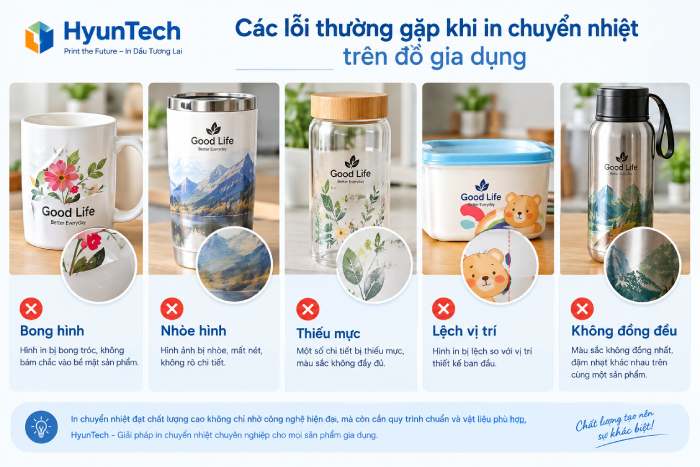
For example, different plastic materials such as PP, ABS, and HDPE have different surface characteristics. If the same transfer configuration is used without testing, problems may occur, including print peeling, incomplete ink transfer, blurred graphics, product deformation, or inconsistent print quality.
For this reason, HyunTech recommends testing the actual product sample before finalizing production parameters for mass production.
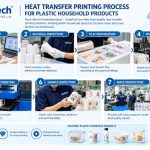
Heat Transfer Printing Process for Household Products at HyunTech
Sample and Requirement Review
The manufacturer provides a product sample or technical information, including:
- Material.
- Dimensions.
- Expected production volume.
- Printing position.
- Print dimensions.
- Artwork file.
- Color requirements.
- Durability requirements.
Product Surface Inspection
HyunTech evaluates the product shape, curvature, surface roughness, coating, and other surface characteristics to determine printing feasibility.
Transfer Film Selection
The heat transfer film is selected based on the substrate material and intended application requirements, rather than simply choosing a film based on color or price.
Sample Testing
This is an important step before mass production.
Sample testing helps evaluate:
- Adhesion.
- Print sharpness.
- Color appearance.
- Image transfer performance.
- Print consistency.
- Resistance under expected usage conditions.
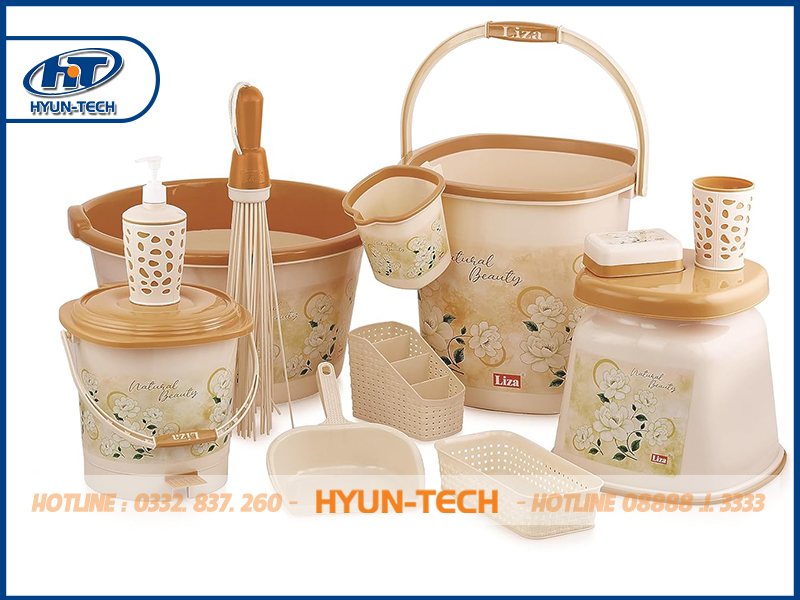
HyunTech Provides Heat Transfer Printing Services for Household Products
Sample Approval and Production
Once the approved sample meets the agreed requirements, HyunTech can proceed with the appropriate printing service or supply the required transfer film according to the manufacturer’s production needs.
Common Heat Transfer Printing Problems on Household Product
| Defect | Appearance | Possible Cause |
|---|---|---|
| Print Peeling | Graphic does not adhere securely | Film incompatibility or unsuitable transfer parameters |
| Blurred Graphics | Edges are not sharp | Unsuitable heat, pressure, time, or fixturing |
| Incomplete Transfer | Some areas are not fully transferred | Surface condition, pressure, or contact is inconsistent |
| Misalignment | Logo is positioned incorrectly | Product fixture is unstable |
| Inconsistent Color | Products differ in color appearance | Production conditions vary between cycles |
| Product Deformation | Product is affected by heat | Transfer parameters are unsuitable for the material |
Printing defects should not be addressed simply by increasing temperature or pressure. The root cause should be evaluated across the entire system, including film, material, surface, fixture, equipment, and operating parameters.
Heat Transfer Printing vs. Decals for Household Products
| Criteria | Heat Transfer Printing | Decals / Adhesive Labels |
|---|---|---|
| Appearance | Can create a more integrated surface appearance | Label edges may be visible |
| Brand Logos | Suitable | Suitable |
| Decorative Patterns | Suitable for a wide range of designs | Depends on decal material |
| High-Volume Production | Can be optimized when the process is stable | Can also be suitable |
| Curved Surfaces | Requires appropriate fixturing and process design | Depends on decal type |
| Aesthetic Requirements | High | Depends on label material |
| Cost | Depends on film, tooling, and production volume | Depends on decal material and processing |
There is no single printing method that is ideal for every product. The choice should be based on material, production volume, product geometry, aesthetic requirements, durability, and production budget.
Heat Transfer Printing Price for Household Products
The cost of heat transfer printing on household products does not have one fixed price for all products. Quotation should be based on the actual product sample and production volume.
| Item | Pricing Basis | Quotation |
|---|---|---|
| Sample Testing | Based on product and testing requirements | Contact us |
| Heat Transfer Film | Based on film type, dimensions, and production volume | Contact us |
| Single-Color Logo Printing | Based on print area and quantity | Sample-based quotation |
| Multi-Color Printing | Based on artwork and film configuration | Sample-based quotation |
| Curved Product Printing | Based on product geometry and fixtures | Project-based quotation |
| High-Volume Production | Based on volume and technical requirements | Volume-based quotation |
| OEM/ODM Orders | Based on product and specific standards | Contact HyunTech |
Note: The table above is a reference pricing structure, not a fixed published price list. For an accurate quotation, manufacturers should provide the product sample + printing area dimensions + production volume + artwork file to HyunTech.
Factors That Determine Heat Transfer Printing Costs
There are six major groups of factors that affect printing costs:
Material: PP, PET, ABS, HDPE, metal, glass, and other materials may require different transfer film structures.
Printing Area: Larger graphics require more film and may increase processing time.
Number of Colors and Artwork: Detailed or multi-color designs may require a more complex film structure and printing process.
Product Shape: Flat products are generally easier to fixture than curved, cylindrical, or multi-angle products.
Production Volume: Larger orders can help optimize preparation and production costs per unit.
Quality Requirements: Products requiring strict color control, adhesion, or durability standards may require more comprehensive testing and quality control.
HyunTech – Heat Transfer Film Supplier and Heat Transfer Printing Service
HyunTech specializes in heat transfer films and industrial decorative printing solutions, serving a wide range of products made from plastic, metal, glass, and other materials for household and industrial applications.
Working directly with a heat transfer film supplier and printing service provider allows manufacturers to discuss multiple technical aspects within the same process, including:
- Product material.
- Artwork design.
- Printing area dimensions.
- Film type.
- Testing method.
- Fixtures.
- Production conditions.
- Production volume.
- Quality requirements.
Rather than simply selecting the lowest-cost film, HyunTech focuses on an integrated film + parameters + process + sample testing solution to help manufacturers reduce risks when moving from prototypes to mass production.
When Should Manufacturers Choose Heat Transfer Printing?
Heat transfer printing on household products is particularly suitable when manufacturers need to:
- Print brand logos directly onto products.
- Add decorative patterns to products.
- Apply branding to OEM products.
- Produce multiple designs within the same product line.
- Manufacture products in high volumes.
- Create consistent product branding.
- Replace certain traditional labeling or decorative methods.
For new products, manufacturers should provide samples for evaluation rather than selecting a printing method based solely on the material name.
Frequently Asked Questions About Heat Transfer Printing on Household Products
Is Heat Transfer Printing on Household Products Durable?
Durability depends on the substrate material, transfer film, surface treatment, transfer parameters, and actual usage conditions. A single durability level should not be assumed for every product. HyunTech recommends testing the actual product sample before mass production.
Which Plastic Household Products Can Be Heat Transfer Printed?
Common materials include PP, PET, ABS, HDPE, PE, and various other plastics. Printability should be confirmed for each specific plastic material and actual surface condition.
Can Multi-Color Logos Be Printed on Household Products?
Yes. Heat transfer films can be designed according to the required image, logo, and colors. For multi-color designs or graphics containing fine details, testing is recommended to verify image reproduction on the actual product.
Is Sample Testing Necessary for High-Volume Production?
Yes. Sample testing helps determine compatibility between the transfer film, substrate, surface, and equipment. It is particularly important before producing thousands or tens of thousands of products.
Does HyunTech Provide Heat Transfer Film and Printing Services?
Yes. HyunTech provides heat transfer film solutions and heat transfer printing services for a wide range of product categories. Manufacturers can provide product samples, product images, material information, printing dimensions, and expected production volumes to receive recommendations for a suitable solution.
Send Your Product Sample for Heat Transfer Printing Consultation
If your company is looking for heat transfer printing services for household products, it is better to provide complete technical information rather than simply asking, “How much does it cost?”
Recommended information to provide includes:
- Product photos or an actual sample.
- Material type, if known.
- Product dimensions.
- Printing area dimensions.
- Logo or artwork file.
- Expected production volume.
- Color requirements.
- Durability requirements.
- Current production method if you are using decals or another decorative method.
Based on this information, HyunTech can recommend the appropriate transfer film, printing method, sample-testing process, and quotation based on the product and production volume.
HyunTech – Heat Transfer Films & Industrial Printing Solutions
Hotline: 0332 837 260 – 088.881.3333
Email: contact@hyuntech.com.vn
Office: Lot BT11, Eurowindow River Park Urban Area, Dong Hoi, Dong Anh, Hanoi, Vietnam
Factory: 312 Nguyen Van Linh, Hung Yen, Vietnam
Do you have household products that need logos, decorative graphics, or brand identification? Send your product sample to HyunTech for printability evaluation, sample testing, and a production-based quotation.