
Heat Transfer Printing on ABS | HyunTech
Heat Transfer Printing on ABS: Applications, Process, Temperature & Cost
Heat transfer printing on ABS is a surface decoration solution used to apply logos, text, images, patterns, and branding designs to products made from ABS plastic. With its lightweight structure, rigidity, good impact resistance, and widespread use in industrial manufacturing, ABS is one of the plastic materials suitable for evaluating Heat Transfer Film (HTF) applications.
HyunTech provides Heat Transfer Film for ABS plastic as well as heat transfer film solutions for various other plastic materials. HyunTech’s product information confirms that its HTF materials can be used with substrates such as PET, ABS, and other plastic materials.
This technology is particularly suitable for manufacturers producing electronic device housings, household appliances, plastic components, automotive and motorcycle accessories, personal products, promotional items, and plastic products requiring brand identification.
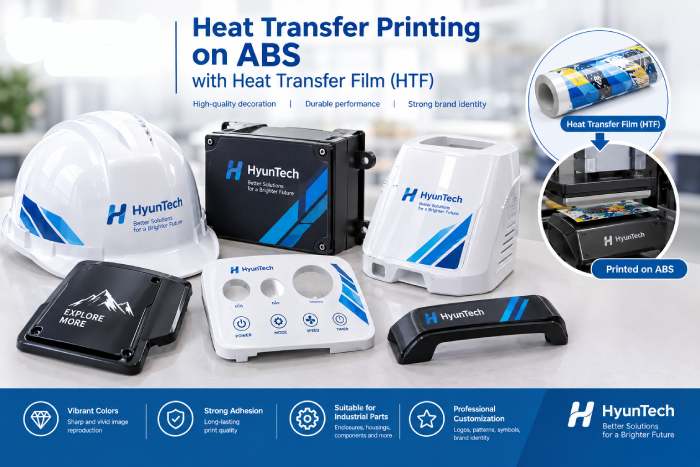
Heat Transfer Printing on ABS Using Heat Transfer Film
Read more:
Heat Transfer Printing for Plastic Products
What Is ABS Plastic and Why Is It Suitable for Heat Transfer Printing?
ABS stands for Acrylonitrile Butadiene Styrene, a thermoplastic widely used to manufacture equipment housings, components, household products, and various technical products.
ABS combines good rigidity, impact resistance, and machinability. However, its thermal characteristics are an important factor to consider when applying heat transfer printing.
Some reference properties of ABS include:
| Property | Reference Value |
|---|---|
| Material name | Acrylonitrile Butadiene Styrene – ABS |
| Material type | Amorphous thermoplastic |
| Glass transition temperature | Approximately 105–115°C |
| Typical HDT | Approximately 80–100°C |
| Thermal conductivity | Approximately 0.14–0.21 W/m·K |
| Impact resistance | Good |
| Processability | Good |
| Applications | Equipment housings, components, household products, accessories |
The thermal values above may vary depending on the ABS grade, formulation, additives, and testing conditions.
Important: The heat transfer pressing temperature should not be taken directly from the injection molding temperature of ABS. These are two completely different processes. For heat transfer printing, the film and pressing parameters should be selected and developed based on the actual product.
What ABS Products Can Be Heat Transfer Printed?
ABS is widely used in both industrial and consumer products. Common applications include:
| Product Category | Possible Printing Content | Purpose |
|---|---|---|
| Electronic device housings | Logos, symbols, patterns | Product identification |
| Household appliance housings | Logos, images | Branding |
| Plastic components | Markings, identification codes | Industrial identification |
| Automotive accessories | Logos, symbols | Decoration |
| Motorcycle accessories | Logos, patterns | Branding |
| ABS plastic boxes | Logos, text, patterns | Commercial branding |
| Personal products | Images, logos | Decoration |
| Plastic toys | Images, characters | Decoration |
| Promotional products | Logos, slogans | Marketing |
| Technical equipment | Symbols, product information | Identification |
Printing Logos on ABS Equipment Housings
Equipment housings are one of the product categories with high demand for surface decoration.
Instead of applying separate labels, manufacturers can evaluate the option of transferring logos or patterns directly onto the plastic surface.
Potential applications include:
- Electrical equipment housings
- Control unit housings
- Household appliance housings
- Machine housings
- Electronic accessory housings
- IoT device housings
Printing Patterns on ABS Components
For products that require identification by product line, model, or brand, heat transfer graphics can be customized according to specific requirements.
When products feature multiple colors or require complex patterns, HTF can be considered as an alternative alongside other direct printing technologies.
Advantages of Heat Transfer Printing on ABS
Full-Color Logos and Graphics
Heat Transfer Film allows the artwork to be prepared before the image is transferred onto the product.
Manufacturers can apply:
- Brand logos
- Slogans
- Images
- Decorative patterns
- Repeating patterns
- Symbols
- Multicolor designs
Consistent Product Appearance
For manufacturers producing multiple product lines, using a standardized design system can improve brand consistency across different ABS products.
Suitable for Industrial Production
Once the film structure and processing parameters have been validated, the process can be standardized for high-volume production.
Reduces Reliance on Adhesive Labels
In some applications, manufacturers want to minimize the appearance or tactile feel of adhesive labels on the product surface. Heat transfer printing can be evaluated as an alternative surface decoration method.
However, the choice between HTF, UV printing, coating, painting, and labels should be based on the material, design, production volume, and actual application requirements.
Technical Parameters to Check Before Printing on ABS
Not all ABS products have the same surface characteristics.
A virgin ABS component, painted ABS, glossy ABS, or surface-treated ABS may produce different heat transfer results.
| Parameter to Check | Example |
|---|---|
| Plastic type | Virgin ABS, ABS with additives |
| Base color | White, black, gray, other colors |
| Surface finish | Glossy, matte, textured |
| Surface coating | With / without coating |
| Product shape | Flat, curved, angled |
| Printing area | According to product drawing |
| Thickness | According to actual component |
| Durability requirement | Decorative or industrial |
| Application conditions | Indoor, outdoor, friction, chemicals, etc. |
How Does the ABS Surface Affect Heat Transfer Printing?
The more uniform the surface, the easier it is to control contact between the film and the product.
By contrast, highly textured surfaces, deep patterns, sharp edges, or complex shapes may require additional evaluation of the fixture and pressing method before production.
This is why testing directly on actual ABS samples is more reliable than relying solely on theoretical material specifications.
What Temperature Is Used for Heat Transfer Printing on ABS?
This is one of the most important questions when researching heat transfer printing on ABS.
ABS has a glass transition temperature of approximately 105–115°C, while the HDT of many ABS grades is around 80–100°C.
Therefore, higher pressing temperatures do not necessarily mean better adhesion.
If heat and pressing time are not properly controlled, the product may experience:
- Deformation
- Warping
- Surface gloss changes
- Surface damage or changes
- Uneven transfer
- Reduced visual quality
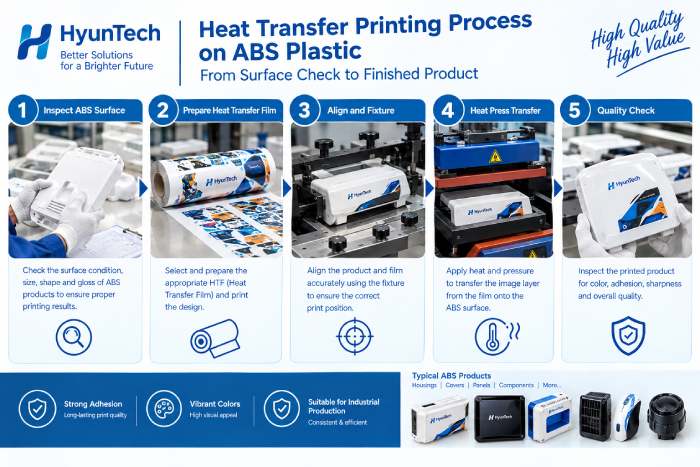
Heat Transfer Printing Process on ABS Plastic
Pressing Parameters Must Be Determined Through Testing
| Parameter | Must Be Determined |
|---|---|
| Pressing temperature | Based on the HTF and ABS grade |
| Pressing time | Based on the film and product |
| Pressure | Based on product shape and printing area |
| Fixturing method | Based on component geometry |
| Film release method | Based on the HTF type |
| Adhesion | Tested after pressing |
| Durability | Tested according to application conditions |
The pressing parameters for one ABS grade or one HTF should not automatically be applied to every ABS product.
HyunTech can evaluate and test samples to determine a suitable heat transfer solution before large-scale production.
Heat Transfer Printing Process on ABS
1. Product Sample Evaluation
The manufacturer provides an ABS sample or product prototype for printing evaluation.
Recommended information includes:
- Product sample
- Dimensional drawing
- Production quantity
- Printing area
- Artwork file
- Color requirements
- Application conditions
2. ABS Surface Inspection
Technicians evaluate whether the product surface is smooth, glossy, matte, textured, or coated with another material.
3. HTF Artwork and Film Preparation
The artwork is adjusted according to the actual product dimensions before being prepared on the Heat Transfer Film.
For industrial products, controlling logo size and positioning should begin during the artwork preparation stage.
4. Heat Transfer Testing
Samples are tested under different pressing conditions to determine the appropriate processing parameters.
Key evaluation criteria include:
- Adhesion
- Image sharpness
- Color consistency
- Position accuracy
- Surface uniformity
- Deformation
- Abrasion resistance according to application requirements
5. Mass Production
After the sample meets the required specifications, the approved parameters are standardized for production according to the required volume.
Is Heat Transfer Printing on ABS Durable?
The durability of the transferred image depends on multiple factors, not just the Heat Transfer Film itself.
A useful way to understand it is:
Durability = HTF + ABS surface + pressing parameters + design + application conditions
If the product is frequently exposed to friction, oil, chemicals, water, or high temperatures, durability requirements should be considered when selecting the appropriate film.
Factors Affecting Durability
| Factor | Impact |
|---|---|
| HTF type | Very high |
| ABS surface | Very high |
| Pressing parameters | Very high |
| Surface coating | High |
| Design | Medium |
| Friction | High |
| Chemicals | Application-dependent |
| Operating temperature | Product-dependent |
For industrial applications, HyunTech recommends providing an actual product sample for testing rather than evaluating compatibility based only on images or general material information.
Reference Pricing for Heat Transfer Printing on ABS
The cost of heat transfer printing on ABS depends on factors such as printing area, production quantity, product geometry, film type, and technical requirements.
| Service | Reference Pricing |
|---|---|
| Simple logo printing on ABS | Contact for quotation |
| Full-color image printing | Contact for quotation |
| ABS equipment housing printing | Contact for quotation |
| ABS component printing | Contact for quotation |
| Heat transfer printing on curved ABS products | Contact for quotation |
| Large-volume production | Quoted according to volume |
| HTF supply for ABS | Quoted according to specifications |
| Sample testing | Contact for quotation |
The pricing above is provided for service classification and is not a fixed HyunTech price list.
For an accurate quotation, manufacturers should provide an ABS sample + printing area dimensions + production quantity + artwork file + durability requirements.
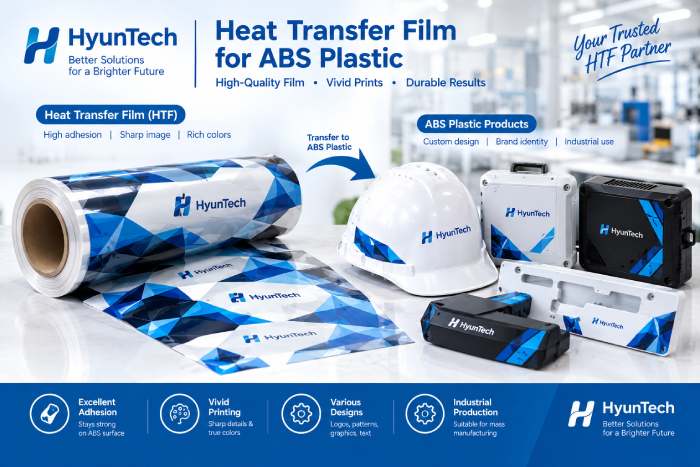
HyunTech Heat Transfer Film for ABS Plastic
Factors That Determine the Cost of ABS Heat Transfer Printing
Production Volume
Larger orders can often optimize film preparation and production setup costs.
Printing Area
A small logo, large logo, or full-surface design will have different material consumption requirements.
Product Geometry
Flat components are generally easier to fixture than curved, cylindrical, or multi-angle components.
Design Complexity
Multicolor artwork, highly detailed graphics, or designs requiring precise positioning may require additional preparation and processing.
Testing Requirements
If the product requires adhesion, abrasion, chemical resistance, or other specialized testing, the testing process may affect both cost and lead time.
Heat Transfer Printing on ABS vs. UV Printing
| Criteria | Heat Transfer Printing | UV Printing |
|---|---|---|
| Logos | Good | Good |
| Full-color graphics | Good | Good |
| Decorative patterns | Good | Good |
| Curved surfaces | Product-dependent | Equipment-dependent |
| 3D products | Can be evaluated | Machine-dependent |
| High-volume production | Suitable | Suitable |
| Product fixturing | Required | Required |
| Customization | High | High |
Technology should not be selected based on price alone.
For ABS products, manufacturers should compare adhesion, durability, color quality, production speed, product geometry, and cost per finished product before selecting the appropriate decoration method.
Common Problems in Heat Transfer Printing on ABS
Uneven Film Adhesion
This may be related to the ABS surface, film type, or pressing parameters.
ABS Deformation
Deformation can occur when the temperature or pressing time is not suitable for the specific ABS grade or product structure.
Blurred Graphics
The artwork, film, pressure, and contact between the film and ABS surface should be checked.
Misaligned Logos
This is often related to product fixturing or film positioning.
Inconsistent Color
The artwork file, ABS base color, film structure, and transfer conditions may need to be reviewed.
Surface Changes After Pressing
The pressing temperature, pressing time, and thermal resistance of the ABS grade should be evaluated.
HyunTech – Heat Transfer Film for ABS Plastic
HyunTech develops and supplies Heat Transfer Film for ABS plastic, along with heat transfer film solutions for various other material groups. HyunTech’s product information indicates that its film materials can be applied to PET, ABS, and other plastics.
For ABS product manufacturers, HyunTech can support the process from sample evaluation and film selection to trial production and heat transfer processing.
Who Can Benefit from HyunTech’s ABS Heat Transfer Solutions?
- Equipment housing manufacturers
- Plastic component manufacturers
- Electrical and electronics companies
- Household appliance manufacturers
- Automotive and motorcycle accessory manufacturers
- Technical plastic product manufacturers
- Promotional product manufacturers
- Companies requiring brand logo printing on ABS products
- Factories purchasing HTF for production
- Manufacturers requiring high-volume heat transfer processing
Send Your ABS Sample – Get Consultation and a Quote from HyunTech
If your company is looking for Heat Transfer Film for ABS, needs logo printing on ABS plastic, or requires a supplier for custom heat transfer printing on ABS, HyunTech can receive your product samples and evaluate the appropriate solution.
For faster consultation, please provide:
ABS product sample
Dimensions of the printing area
Estimated production quantity
Logo or artwork file
Desired colors
Product application conditions
Required durability
Based on the actual sample, HyunTech can evaluate:
ABS surface → Film selection → Heat transfer testing → Adhesion testing → Production solution
HyunTech Holdings
- Hotline: 0332 837 260 – 0888 813 333
- Email: contact@hyuntech.com.vn
- Office: Lot BT11, Eurowindow River Park Urban Area, Dong Hoi, Dong Anh, Hanoi, Vietnam
- Factory: 312 Nguyen Van Linh, Hung Yen, Vietnam
- Heat Transfer Processing Facility: Doai Village, Tam Xa, Dong Anh, Hanoi, Vietnam
- Website: hyuntech.com.vn
Need heat transfer printing on ABS? Send your sample to HyunTech for film consultation, practical testing, and a product-specific quotation.
Frequently Asked Questions About Heat Transfer Printing on ABS
What is heat transfer printing on ABS?
Heat transfer printing on ABS is a surface decoration process that uses Heat Transfer Film (HTF), heat, and pressure to transfer logos, text, images, or patterns onto ABS plastic products.
Can ABS plastic be heat transfer printed?
Yes. ABS is one of the plastic materials for which HyunTech provides Heat Transfer Film solutions. However, transfer performance and adhesion should be evaluated according to the ABS grade, surface condition, coating, and actual product.
What temperature is used for heat transfer printing on ABS?
There is no single temperature suitable for every ABS product. Because ABS thermal characteristics vary by material grade, the appropriate temperature, pressing time, and pressure should be determined through testing with the specific HTF and product.
Is heat transfer printing on ABS durable?
Durability depends on the film type, ABS surface, pressing parameters, and application conditions. If the product is exposed to frequent friction, chemicals, or high temperatures, testing under actual operating conditions is recommended before mass production.
Does HyunTech supply Heat Transfer Film and provide heat transfer printing on ABS?
HyunTech supplies Heat Transfer Film for ABS and other material groups and provides custom heat transfer processing solutions. Manufacturers can send their ABS samples, artwork, and production requirements to receive consultation on the appropriate solution.
Bài viết cùng chủ đề
-
 Waterproof Printing Technology for Packaging
-
 Heat Transfer Film for Bottles – Durable Printing
-
 In Mould Labeling vs Shrink Sleeve: Cost & Quality
-
 Custom Printed Plastic Packaging for Brands: Complete Guide
-
 Heat Transfer Printing on Aluminum | HyunTech
-
 IML Labelling: Process, Cost 2026 & Top Supplier