
Heat Transfer Printing on Aluminum | HyunTech
Heat Transfer Printing on Aluminum is a surface decoration technology used to transfer logos, graphics, text, patterns, wood grain, stone textures and other visual designs onto aluminum surfaces.
For manufacturers, packaging companies, industrial product suppliers and OEM/ODM businesses, aluminum offers a rigid, lightweight and durable substrate. However, achieving consistent transfer quality requires more than simply applying heat and pressure. Aluminum alloy, surface treatment, coating, geometry, transfer film, temperature, pressure and dwell time all affect the final result.
HyunTech provides Heat Transfer Film (HTF) and heat transfer printing solutions for aluminum products, including sample testing, process development and production support.
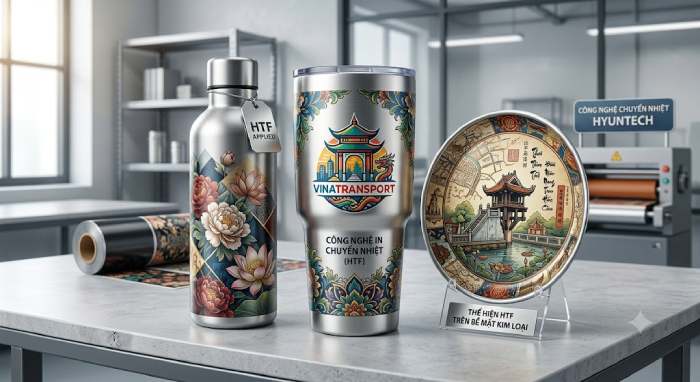
Heat Transfer Printing on Aluminum Using Heat Transfer Film
Read more: What Is Heat Transfer Printing?
What Is Heat Transfer Printing on Aluminum?
Heat Transfer Printing on Aluminum is a process in which a printed transfer film or transfer paper is positioned against an aluminum surface and transferred using controlled heat and pressure.
Depending on the film and aluminum surface, the technology can be used to create:
- Product logos
- Brand names
- Text and symbols
- Decorative graphics
- Wood-grain patterns
- Stone-grain effects
- Technical identification
- Product markings
- Promotional designs
- Custom OEM/ODM patterns
The final appearance depends strongly on the compatibility between the Heat Transfer Film and the aluminum surface.
Unlike printing directly with conventional ink, heat transfer printing separates the graphic layer from the printing process and allows the film to carry the required design onto the target surface.
Why Aluminum Is Suitable for Heat Transfer Printing
Aluminum is widely used in industrial products because of its combination of low weight, rigidity, corrosion resistance and machinability.
Common aluminum substrates include aluminum sheets, profiles, panels, housings, covers, plates and formed components.
| Aluminum characteristic | Relevance to heat transfer printing |
|---|---|
| Lightweight | Suitable for products requiring reduced overall weight |
| Rigid surface | Supports accurate positioning of graphics |
| Good thermal conductivity | Heat distribution must be considered during process development |
| Available in different finishes | Surface condition affects adhesion and appearance |
| Easy to machine | Suitable for flat and formed components |
| Widely used industrially | Suitable for OEM/ODM product decoration |
The surface condition is particularly important. Raw aluminum, anodized aluminum, coated aluminum and pre-treated aluminum may require different transfer-film systems and process parameters.
Aluminum Surface Types
Before production, HyunTech recommends identifying the actual aluminum surface rather than treating all aluminum products as the same substrate.
| Aluminum surface | Typical consideration |
|---|---|
| Raw aluminum | Requires suitable surface preparation and compatible transfer system |
| Anodized aluminum | Surface chemistry and finish must be evaluated |
| Painted/coated aluminum | Transfer compatibility depends on coating composition |
| Powder-coated aluminum | Adhesion and heat resistance should be tested |
| Brushed aluminum | Grain direction may influence visual appearance |
| Polished aluminum | Surface cleanliness and adhesion are critical |
| Textured aluminum | Film conformity and pressure distribution require testing |
[VỊ TRÍ ẢNH]
Image Name: aluminum-surface-types-heat-transfer.jpg
Alt: Aluminum surface types for heat transfer printing
Description: Comparison of raw, anodized, coated, brushed and polished aluminum surfaces suitable for different heat transfer printing applications.
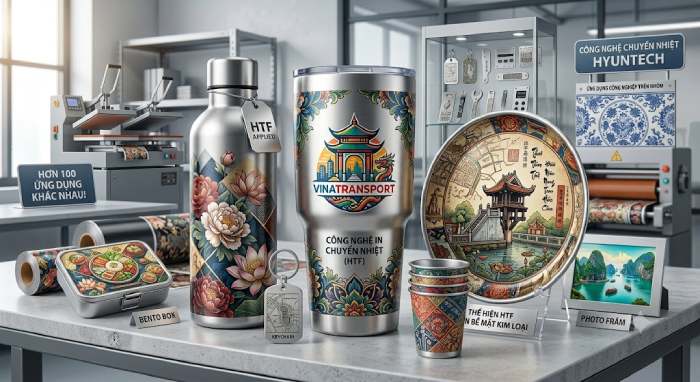
Aluminum Products Suitable for Heat Transfer Printing
Heat Transfer Printing Process on Aluminum
A controlled process is essential when transferring graphics onto aluminum.
Aluminum Surface Inspection
The first step is to inspect the aluminum product.
Important factors include:
- Aluminum alloy or material specification
- Surface treatment
- Coating type
- Surface roughness
- Product dimensions
- Curvature
- Print area
- Required graphic position
- Expected durability
- Production quantity
Oil, dust, oxidation, release agents or other surface contaminants can affect transfer quality.
Surface Cleaning and Preparation
The aluminum surface should be cleaned according to its actual surface treatment.
For industrial production, the cleaning method should be selected based on the coating and aluminum surface rather than using one cleaning method for every product.
The objective is to provide a clean, stable surface for the transfer system.
Heat Transfer Film Preparation
The Heat Transfer Film is selected according to:
- Aluminum surface
- Required graphic
- Color requirements
- Product geometry
- Adhesion requirements
- Abrasion requirements
- Production volume
- Expected application environment
The film is then cut according to the required printing area.
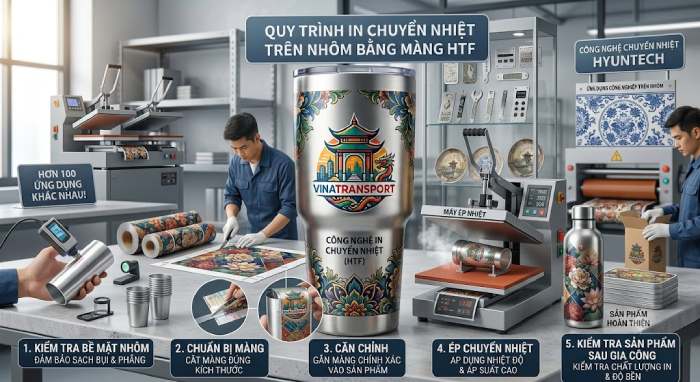
Positioning and Alignment
Accurate positioning becomes particularly important for industrial components.
For products containing logos, technical symbols, buttons, product codes or decorative patterns, even a small positional deviation can affect the appearance of the finished product.
HyunTech can develop positioning and jig solutions according to the geometry of the product.
Heat and Pressure Transfer
The transfer film is positioned on the aluminum surface and subjected to controlled heat and pressure.
There is no single universal temperature, time or pressure setting for every aluminum product. The appropriate parameters depend on the Heat Transfer Film, aluminum surface, coating, product geometry, equipment and required performance.
Published aluminum transfer methods provide reference conditions such as approximately 170–190°C and 18–25 seconds, while other aluminum transfer processes use different combinations of temperature, time and pressure. These values should therefore be treated as process references rather than universal production settings.
Post-Transfer Inspection
After transfer, the product should be inspected for:
- Graphic completeness
- Edge definition
- Color consistency
- Position accuracy
- Adhesion
- Scratches
- Wrinkles
- Bubbles
- Peeling
- Surface contamination
For mass production, inspection criteria should be established during sample approval.
Heat Transfer Printing Parameters for Aluminum
Temperature, time and pressure are three important process variables, but they should be developed together with the specific transfer film and substrate.
Reference Process Parameters
The following values are useful as reference data for process development, not as universal production settings.
| Parameter | Reference value | Notes |
|---|---|---|
| Transfer temperature | 170–190°C | Depends on film, coating and aluminum surface |
| Transfer time | 18–25 seconds | Must be validated through sample testing |
| Vacuum pressure for certain vacuum processes | 0.3–0.8 MPa | Applicable only to specific vacuum transfer processes |
| Example transfer temperature | 190°C | Reported in specific aluminum transfer methods |
| Example transfer time | 18 seconds | Reported in specific aluminum transfer methods |
| Aluminum sheet thickness in one published method | 0.15 mm | Example process condition, not a universal requirement |
| Transfer-medium thickness in one published method | 65 μm | Example process condition |
Published technical documents describe aluminum heat-transfer processes using conditions such as 190°C/18 seconds and aluminum sheet thicknesses including 0.15 mm in specific embodiments.
Other aluminum printing technologies use different settings. For example, one commercial sublimation-aluminum system specifies approximately 195°C with a dwell time of 90–120 seconds, demonstrating why process parameters cannot simply be transferred from one printing technology to another.
Why Parameter Testing Is Important
Incorrect parameters may result in:
- Weak adhesion
- Incomplete transfer
- Blurred graphics
- Wrinkles
- Uneven color
- Film residue
- Surface damage
- Deformation of coated products
- Inconsistent production batches
For this reason, HyunTech recommends testing the actual aluminum product and actual Heat Transfer Film before mass production.
Applications of Heat Transfer Printing on Aluminum
Heat Transfer Printing on Aluminum can be used across a wide range of industrial and commercial products.
Aluminum Panels and Plates
Aluminum panels can be decorated with:
- Logos
- Product information
- Decorative patterns
- Wood grain
- Stone patterns
- Technical identification
- Brand graphics
Aluminum Profiles
Aluminum profiles can be used in:
- Interior products
- Furniture components
- Architectural applications
- Decorative systems
- Industrial equipment
The transfer process must account for profile geometry and the accessible printing surface.
Aluminum Housings and Covers
Heat transfer printing can add product identification and branding to:
- Electrical housings
- Electronic equipment
- Machine covers
- Control boxes
- Industrial equipment
- Consumer products
Aluminum Industrial Components
Industrial components may require:
- Product codes
- Technical symbols
- Direction indicators
- Warning symbols
- Model numbers
- Batch identification
- Brand logos
For these applications, print positioning and consistency between production batches are particularly important.
Decorative Aluminum Products
Heat transfer technology can also create decorative finishes such as:
- Wood grain
- Stone grain
- Metallic effects
- Custom patterns
- Brand-specific graphics
Certain published aluminum transfer processes specifically describe the use of heat transfer films or papers to create wood-grain and stone-grain decorative effects on aluminum plates.
Heat Transfer Printing on Aluminum vs. Other Printing Methods
Different technologies may be suitable depending on the aluminum surface, design and production requirements.
| Technology | Main advantage | Consideration |
|---|---|---|
| Heat Transfer Printing | Suitable for detailed graphics and decorative patterns | Requires substrate-film compatibility testing |
| UV Printing | Direct digital printing and flexible artwork | Surface pretreatment and adhesion may be important |
| Screen Printing | Suitable for certain industrial graphics | Less flexible for complex variable designs |
| Pad Printing | Useful for small or irregular areas | Printing area and graphic size can be limited |
| Dye Sublimation | Suitable for specially coated aluminum | Requires compatible polymer-coated aluminum |
| Laser Marking | Permanent identification without ink | Mainly suited to marking rather than full-color graphics |
The choice should be based on the actual product, required appearance, durability, production volume and cost target.
Quality Control for Aluminum Heat Transfer Printing
For B2B and OEM production, visual inspection alone may not be sufficient.
HyunTech can establish product-specific quality criteria based on the customer’s requirements.
Key Quality Criteria
| Quality item | What should be checked |
|---|---|
| Adhesion | Graphic should remain bonded to the intended surface |
| Position accuracy | Logo or graphic must remain within agreed tolerance |
| Color | Color should remain consistent across approved batches |
| Edge definition | Graphic edges should be clean and well defined |
| Surface appearance | No unacceptable wrinkles, bubbles or contamination |
| Abrasion resistance | Tested according to the customer’s application |
| Heat resistance | Evaluated according to actual use conditions |
| Batch consistency | Same design and quality standard across production runs |
Durability should be tested under the actual intended use conditions rather than assumed solely from the transfer process.
Common Problems in Heat Transfer Printing on Aluminum
Poor Adhesion
Possible causes include:
- Incompatible HTF
- Contaminated surface
- Unsuitable coating
- Incorrect temperature
- Insufficient pressure
- Insufficient transfer time
Uneven Transfer
Possible causes include:
- Uneven pressure
- Irregular product geometry
- Poor film positioning
- Uneven heating
- Incorrect jig design
Blurred or Distorted Graphics
Possible causes include:
- Film movement during transfer
- Incorrect pressure
- Incorrect process parameters
- Product deformation
- Improper alignment
Color Inconsistency
Color variation can result from differences in:
- Film batch
- Aluminum surface
- Coating
- Heating conditions
- Transfer parameters
- Equipment calibration
For mass production, these factors should be controlled during sample approval and production setup.
Reference Pricing for Heat Transfer Printing on Aluminum
The actual cost of Heat Transfer Printing on Aluminum depends on the product and production requirements. A fixed price cannot be accurately applied to every aluminum product.
| Cost factor | Impact on quotation |
|---|---|
| Product size | Larger printing area may require more film and processing time |
| Printing area | Affects material consumption |
| Graphic complexity | Complex graphics may require additional preparation |
| Aluminum surface | Different surfaces may require different processing |
| Product geometry | Irregular shapes may require special jigs |
| Quantity | Larger production runs may reduce unit processing cost |
| Color/design | Affects film and production requirements |
| Sample development | Initial testing may require separate setup |
| Quality requirements | Additional inspection can affect production cost |
| Packaging | Product protection requirements affect logistics cost |
B2B Quotation Example
| Project | Quantity | Printing requirement | Pricing |
|---|---|---|---|
| Prototype | 10–50 pcs | Sample development | Contact HyunTech |
| Small batch | 100–500 pcs | Standard graphic | Quotation required |
| Medium batch | 1,000–5,000 pcs | OEM production | Project-based quotation |
| Large batch | 10,000+ pcs | Mass production | Negotiated B2B quotation |
Note: The table is a quotation framework rather than a fixed HyunTech price list. Actual pricing should be calculated after reviewing the aluminum product, dimensions, surface treatment, artwork, quantity and required quality standard.
Why Choose HyunTech for Heat Transfer Printing on Aluminum?
HyunTech focuses on industrial Heat Transfer Film and heat transfer printing solutions for rigid products.
The company can support customers from sample development to production, rather than simply supplying a transfer film.
HyunTech’s Solution Includes
- Heat Transfer Film selection
- Aluminum surface evaluation
- Artwork and printing-area assessment
- Sample testing
- Transfer parameter development
- Positioning and jig considerations
- Production processing
- Quality inspection
- OEM/ODM support
- B2B mass-production support
HyunTech’s Heat Transfer Film solutions are designed for applications involving rigid substrates, with process development based on the actual material and product structure.
Get a Heat Transfer Printing Solution for Your Aluminum Products
If your company needs Heat Transfer Printing on Aluminum, HyunTech can evaluate the actual product and recommend a suitable transfer-film and processing solution.
For an accurate quotation and technical assessment, customers should provide:
- Aluminum product sample or product photos
- Product dimensions
- Aluminum surface treatment
- Printing area
- Artwork or logo
- Expected quantity
- Required durability
- Application environment
- Target delivery schedule
Instead of choosing transfer parameters based on generic specifications, HyunTech can develop the process around the actual aluminum product and production requirements.
Need Heat Transfer Film or Heat Transfer Printing on Aluminum? Contact HyunTech for sample testing, technical consultation and B2B quotation.
Hotline: 0332 837 260 – 088.881.3333
Email: contact@hyuntech.com.vn
Office: Lô BT11, KĐT Eurowindow River Park, Đông Hội, Đông Anh, Hà Nội
Factory: 312 Nguyễn Văn Linh, Hưng Yên
Transfer Processing Workshop: Thôn Đoài, Tàm Xá, Đông Anh, Hà Nội
Frequently Asked Questions About Heat Transfer Printing on Aluminum
Can Heat Transfer Printing be used on aluminum?
Yes. Heat transfer printing can be applied to suitable aluminum surfaces using a compatible Heat Transfer Film and a properly developed process. Surface treatment, coating and product geometry should be evaluated before mass production.
What temperature is used for Heat Transfer Printing on aluminum?
There is no universal temperature. Published aluminum transfer methods include reference conditions around 170–190°C, while specific processes may use different temperature and time combinations. The actual setting should be established through sample testing.
Can Heat Transfer Printing create wood-grain patterns on aluminum?
Yes. Heat transfer methods have been documented for applying wood-grain and stone-grain decorative effects to aluminum plates.
Is Heat Transfer Printing on aluminum suitable for industrial products?
Yes, provided that the transfer film, aluminum surface and process are properly matched. It can be used for logos, product identification, technical graphics and decorative finishes on aluminum components and housings.
How can I get a quotation for Heat Transfer Printing on aluminum?
Send HyunTech the aluminum product sample or specifications, printing artwork, dimensions, surface treatment and expected quantity. HyunTech can then evaluate the application, conduct sample testing when required and provide a project-based quotation.
HyunTech – Heat Transfer Film & Industrial Heat Transfer Printing Solutions
Visit HyunTech for Heat Transfer Printing solutions
Bài viết cùng chủ đề
-
 IML Labelling: Process, Cost 2026 & Top Supplier
-
 HEAT TRANSFER PRINTING ON TET GIFT BOXES
-
 Đâu là công nghệ in chai serum thủy tinh thịnh hành hiện nay?
-
 OEM Packaging Printing Solutions for Private Label Brands
-
 High-End Packaging Printing for Luxury Product Brands
-
 Durable Packaging for Household Products: Trends & Solutions