
Key Specifications of Heat Transfer Film
Heat transfer film specifications are the foundation of high-quality printing, durability, and production efficiency across industries such as plastics, packaging, electronics, and consumer goods. Understanding heat transfer film thickness, heat transfer film temperature range, and heat transfer film adhesion properties helps manufacturers reduce defects, optimize costs, and improve product value.
1. What Are Heat Transfer Film Specifications?
Heat transfer film specifications refer to the full set of technical parameters required for successful heat transfer printing, including:
- Film thickness
- Temperature range
- Adhesion properties
- Pressure
- Dwell time
- Substrate compatibility (PP, PE, ABS, PET, metal, etc.)
These parameters form the core heat transfer film technical parameters used in industrial production.
2. Heat Transfer Film Thickness
Heat transfer film thickness is one of the most critical industrial heat transfer film specs, directly affecting print clarity, flexibility, and durability.
Standard Thickness Table
| Film Type | Thickness (micron) | Application |
|---|---|---|
| Thin film | 12 – 16 µm | Flexible packaging, lightweight products |
| Medium film | 18 – 25 µm | Household plastics, bottles |
| Thick film | 30 – 50 µm | Industrial parts, textured surfaces |
👉 Key insights:
- Too thin → tearing risk, unstable printing
- Too thick → poor adhesion, higher cost
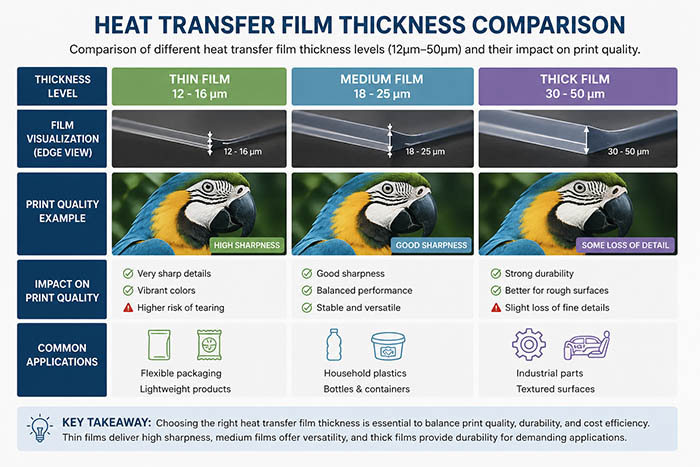
Comparison of different heat transfer film thickness levels
3. Heat Transfer Film Temperature Range
The heat transfer film temperature range determines how effectively the ink layer bonds to the substrate.
Standard Temperature by Material
| Material | Temperature (°C) | Time (seconds) |
|---|---|---|
| PP | 120 – 140°C | 8 – 12s |
| PE | 110 – 130°C | 6 – 10s |
| ABS | 140 – 180°C | 10 – 15s |
| PET | 130 – 160°C | 8 – 12s |
👉 This is the typical heat transfer film temperature range used in industrial production.
Incorrect temperature can cause:
- Low temperature → weak adhesion
- High temperature → film burning or deformation
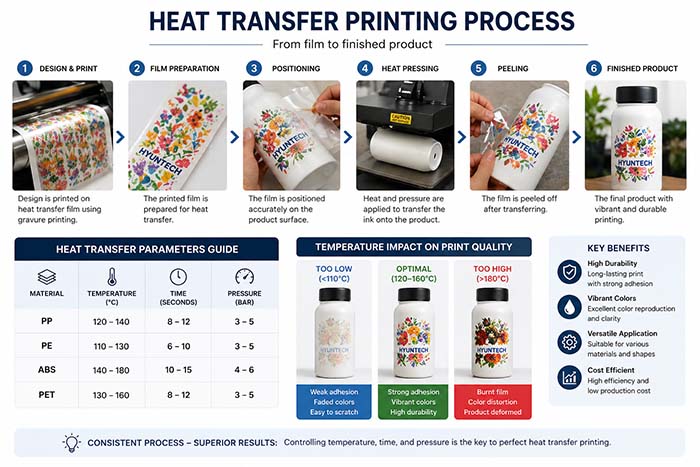
Illustration of the heat transfer printing process at different temperature levels on plastic surfaces.
4. Heat Transfer Film Adhesion Properties
Heat transfer film adhesion properties determine how well the printed layer sticks to the substrate and resists wear.
Adhesion Testing Methods
| Test Method | Description |
|---|---|
| Cross-cut test | Surface cutting to evaluate peeling |
| Tape test | Adhesion check using tape |
| Abrasion resistance | Resistance to friction |
| Chemical resistance | Resistance to chemicals |
Adhesion Rating Scale
| Rating | Evaluation |
|---|---|
| 5B | No peeling (best) |
| 4B | Slight peeling |
| ≤3B | Not acceptable |
👉 Industrial standards typically require 4B–5B adhesion.
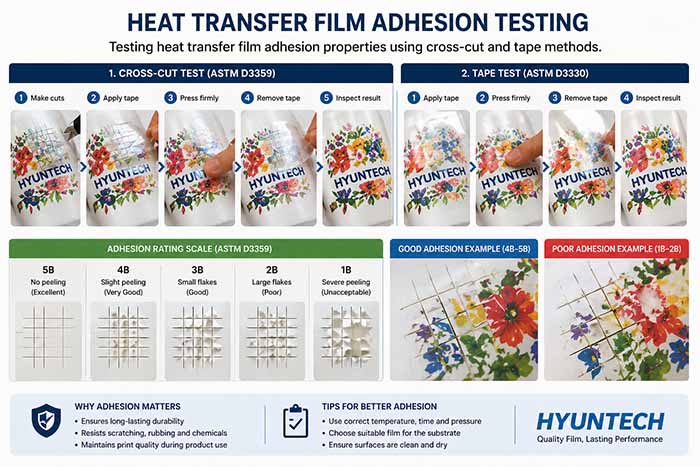
Testing heat transfer film adhesion properties using cross-cut and tape methods
5. Summary of Heat Transfer Film Technical Parameters
| Parameter | Standard Range |
|---|---|
| Thickness | 12 – 50 µm |
| Temperature | 110 – 180°C |
| Pressure | 3 – 6 bar |
| Dwell time | 6 – 15 seconds |
| Adhesion | 4B – 5B |
👉 These are the essential heat transfer film specifications for consistent production quality.
6. Heat Transfer Film Price Reference (2026)
| Film Type | Price (USD/m²) | Notes |
|---|---|---|
| Standard film | $1.0 – $1.6 | High-volume production |
| Mid-range film | $1.6 – $3.0 | High-quality printing |
| Premium film | $3.0 – $5.0 | High adhesion, scratch-resistant |
👉 Pricing depends on:
- Film thickness
- Number of colors
- Technical requirements
7. Applications of Heat Transfer Film
- Cosmetic and food packaging
- Electronic components
- Household plastic products
- Automotive interiors
Choosing the right industrial heat transfer film specs helps:
- Improve product durability
- Reduce production defects
- Optimize manufacturing costs
8. Why Choose Hyuntech?
Hyuntech is a trusted supplier of high-performance heat transfer film specifications, offering:
- ✅ Custom technical parameters for each product
- ✅ High adhesion (up to 5B standard)
- ✅ Stable temperature performance
- ✅ Competitive factory pricing
- ✅ Free technical consultation
👉 Hyuntech not only supplies film but also helps optimize your entire heat transfer printing process.
9. Conclusion
Understanding heat transfer film specifications is essential for achieving consistent print quality and production efficiency. From heat transfer film thickness to temperature range and adhesion properties, each parameter plays a critical role in the final product.
If you are looking for a reliable and cost-effective heat transfer film solution, Hyuntech is your ideal partner.
👉 Contact Hyuntech today for expert consultation and the best quotation!
Readmore: Types of Heat Transfer Film Used in Industrial Production
Bài viết cùng chủ đề
-
 Innovative Dairy Packaging Solutions for Milk & Yogurt Brands
-
 Heat Transfer Film for Plastic Packaging: Applications & Benefits
-
 Heat Transfer Film Applications in Plastic Packaging Industry
-
 Heat Transfer Film for Bottles – Durable Printing
-
 Plastic Container Printing Solutions for Packaging
-
 Top Packaging Solutions for FMCG Brands in 2026