
In Mould Labelling (IML): Process, Applications and Benefits
In mould labelling (IML) is a decoration and labelling technology used to apply pre-printed labels directly to plastic products during the moulding process. Unlike conventional labelling, where a label is attached after a product has been manufactured, IML integrates the label with the plastic product during injection moulding.
This technology is widely used for plastic packaging and containers that require high-quality graphics, consistent appearance, durability and efficient large-scale production.
For manufacturers looking for a reliable in mould labelling solution, understanding the IML process, suitable materials, applications and production requirements is essential before starting a project.

What Is In Mould Labelling?
In mould labelling, commonly abbreviated as IML, is a manufacturing process in which a pre-printed label is placed inside an injection mould before plastic is injected.
During the moulding process, the plastic material is injected into the mould and bonds with the label. The label becomes an integrated part of the finished product rather than being applied as a separate sticker after production.
The result is a plastic product with graphics, logos, product information or decorative designs integrated into its surface.
Depending on the product and production method, IML can provide:
- High-quality graphics and detailed designs
- Consistent label positioning
- Strong integration between the label and plastic product
- Good resistance to moisture and handling
- Efficient decoration for high-volume production
- A clean and professional packaging appearance
Because the label is integrated during moulding, in mould labelling can be particularly suitable for manufacturers producing large quantities of plastic packaging.
How Does In Mould Labelling Work?
The basic in mould labelling process combines label preparation, mould positioning and plastic injection moulding.
Although production equipment and parameters vary depending on the product, a typical IML process includes the following stages.
1. Label Design and Printing
The first step is preparing the artwork for the IML label.
The design may include:
- Brand logos
- Product names
- Images and graphics
- Product information
- Decorative patterns
- Barcodes and symbols
- Colours and visual elements
The label material, printing method and surface finish need to be selected according to the plastic product and its intended application.
2. Label Preparation
After printing, the labels are cut into the required shape and size.
The dimensions must correspond accurately to the mould cavity and the intended label position on the product.
For complex products, factors such as curved surfaces, corners, wall thickness and label placement need to be considered during development.
3. Label Placement Inside the Mould
The prepared label is positioned inside the injection mould.
Depending on the production system, automated equipment or robotic systems may be used to transfer and position the labels accurately.
Correct positioning is important because it affects:
- Label alignment
- Graphic position
- Product appearance
- Production consistency
- Overall quality
4. Plastic Injection Moulding
Once the label is correctly positioned, plastic resin is injected into the mould.
The heat and pressure generated during the moulding process allow the plastic and label to form an integrated structure.
The exact processing conditions depend on factors such as:
- Plastic material
- Label construction
- Product geometry
- Mould design
- Injection speed
- Temperature
- Pressure
- Cooling conditions
5. Cooling and Demoulding
After injection, the plastic product is cooled before being removed from the mould.
The finished product then contains the integrated label on its surface.
6. Quality Inspection
The final products are inspected for:
- Label positioning
- Colour consistency
- Print sharpness
- Surface appearance
- Adhesion or integration
- Dimensional accuracy
- Defects or deformation
For industrial production, inspection criteria should be defined during the sample-development stage before mass production begins.
IML printing for paint buckets
IML printing for paint buckets
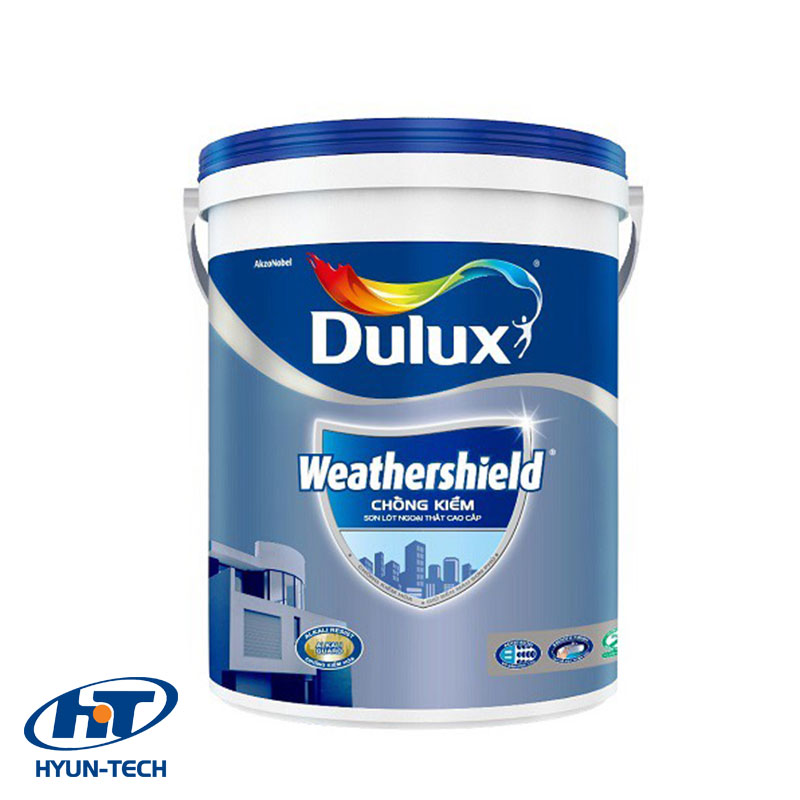
IML printing for paint buckets
In Mould Labelling vs Conventional Labelling
One of the main differences between in mould labelling and conventional labelling is when the label is applied.
With conventional labelling, the plastic product is manufactured first and the label is attached afterwards.
With IML, the label is introduced into the mould before or during injection moulding and becomes integrated with the finished plastic product.
| Feature | In Mould Labelling (IML) | Conventional Labelling |
|---|---|---|
| Label application | During moulding | After production |
| Product appearance | Integrated and uniform | Separate label layer |
| Position consistency | High when properly automated | Depends on application process |
| Production integration | Integrated with moulding | Additional labelling stage |
| Graphic possibilities | Suitable for detailed designs | Depends on label material and process |
| Large-volume production | Highly suitable | Also possible |
| Automation | Suitable for automated production | Depends on equipment |
The appropriate technology depends on the product structure, production volume, required appearance, material and manufacturing process.
Key Benefits of In Mould Labelling
High-Quality Product Appearance
One of the main advantages of in mould labelling is its ability to create a clean and professional appearance.
High-resolution graphics, logos, product information and decorative elements can be incorporated into the product surface.
This makes IML suitable for packaging where visual presentation is an important part of product identity.
Consistent Label Positioning
For automated production, IML can provide consistent label positioning from one product to another.
Accurate positioning is particularly important for packaging with:
- Brand logos
- Product information
- Decorative graphics
- Multiple-colour designs
- Front and back artwork
Suitable for High-Volume Production
IML is particularly useful for industrial manufacturers producing large quantities of identical or similar plastic products.
Once the moulding and label-handling process has been properly developed, production can be integrated into a streamlined manufacturing workflow.
Durable Product Decoration
Because the label becomes integrated with the plastic product during moulding, the finished decoration can provide a different durability profile from a separately applied adhesive label.
The actual performance depends on the label construction, plastic material, printing system, product design and intended environment.
For applications requiring specific durability, testing should be carried out using the actual product and production conditions.
Supports Complex Graphics
IML can be used for detailed artwork, brand identity, images, patterns and other visual elements.
This makes the technology suitable for products where packaging appearance and brand presentation are important.
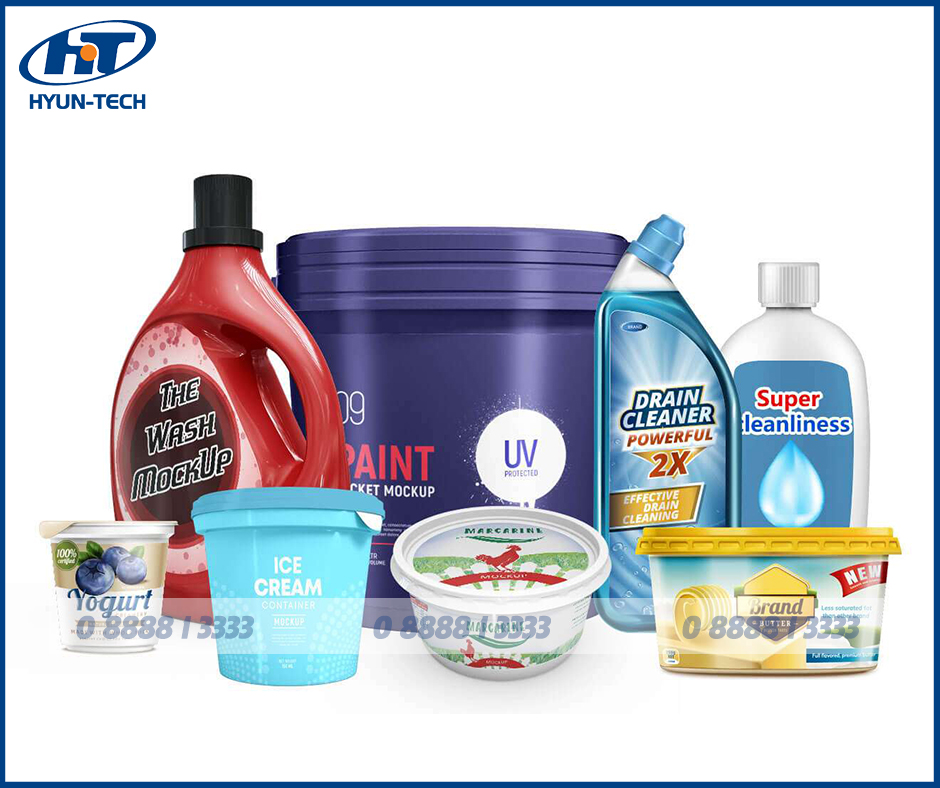
Enhancing print quality in in-mold labeling
Applications of In Mould Labelling
In mould labelling is used across various plastic packaging and product categories.
Food Packaging
IML is commonly considered for plastic food packaging such as:
- Food containers
- Plastic tubs
- Storage containers
- Yogurt and dairy containers
- Takeaway packaging
- Lids and covers
The label can display product branding, graphics, product information and other required content.
Household Products
IML can also be applied to household plastic products, including:
- Storage boxes
- Cleaning-product containers
- Household liquid bottles
- Plastic bins
- Trays
- Containers
- Kitchen accessories
The technology can help manufacturers create consistent product identification across large production runs.
Cosmetic and Personal Care Packaging
For cosmetic and personal care packaging, visual appearance is often an important consideration.
Potential applications include:
- Cosmetic containers
- Cream jars
- Personal-care packaging
- Plastic bottles
- Caps and lids
Detailed graphics and carefully controlled colour reproduction can support brand presentation.
Industrial Plastic Products
IML can also be considered for selected industrial plastic components and products requiring integrated identification or decorative graphics.
Applications may include:
- Plastic housings
- Covers
- Containers
- Equipment components
- Product identification surfaces
The suitability of IML depends on the material, geometry, mould structure and production requirements.
What Materials Can Be Used for In Mould Labelling?
The plastic material is one of the most important factors when developing an IML application.
Common plastic materials used in packaging and injection moulding include:
- PP
- PE
- PET
- HDPE
- ABS
- PS
- PVC
- PMMA
However, simply identifying the plastic as a material category is not always sufficient.
Different resin grades, additives, colours, surface finishes and processing conditions can affect the final result.
For this reason, a product sample or detailed technical information is recommended when evaluating an in mould labelling project.
What Factors Affect In Mould Labelling Quality?
A successful IML application depends on more than the label itself.
Plastic Material
Different plastics have different processing characteristics and surface properties.
The selected label and printing system should therefore be evaluated against the actual plastic material.
Product Shape
Flat, cylindrical, curved and complex surfaces may require different approaches.
Product geometry can influence:
- Label positioning
- Label deformation
- Graphic distortion
- Mould design
- Automation
Mould Design
The mould plays a critical role in IML production.
The label size, position, cavity structure and product geometry need to work together to achieve a consistent result.
Label Construction
The label material, thickness, printing technology, surface treatment and other characteristics can affect how the label performs during moulding.
Processing Conditions
Temperature, injection pressure, injection speed, cooling conditions and other production parameters can influence the final appearance and quality.
There is therefore no single universal temperature or processing setting for every in mould labelling application.
Production parameters should be established through technical testing using the actual materials, mould and product.
Common In Mould Labelling Problems
During IML development or production, several issues may occur if the label, mould and processing conditions are not properly matched.
Label Misalignment
The label may not be positioned correctly inside the mould.
Possible contributing factors include:
- Incorrect label dimensions
- Positioning problems
- Mould or fixture tolerances
- Automation issues
- Product geometry
Graphic Distortion
Images, text or logos may appear distorted when the label is affected by product shape or moulding conditions.
This is particularly important for curved or complex surfaces.
Poor Surface Appearance
The finished product may show visual defects such as uneven appearance, wrinkles or other surface inconsistencies.
These issues may be related to label construction, mould conditions, material behaviour or processing parameters.
Inconsistent Colour or Print Quality
Differences in printing, material or production conditions can affect colour consistency.
For branded packaging, colour standards and production samples should be reviewed before mass production.
Adhesion or Integration Issues
If the label and plastic material are not properly matched, the finished product may not achieve the required level of integration.
Testing with the actual resin, label and production process is therefore important.
In Mould Labelling Process at HDEcal
For manufacturers looking for an in mould labelling solution in Vietnam, HDEcal can support the project from technical consultation and sample evaluation through production preparation.
A typical development process can include:
Step 1: Submit Product Information
Customers provide information such as:
- Product sample
- Product photos
- Plastic material
- Product dimensions
- Label dimensions
- Label position
- Quantity
- Artwork or logo
- Required durability
- Intended application environment
Providing an actual product sample is particularly useful when the product geometry or surface characteristics cannot be fully evaluated from photographs.
Step 2: Technical Evaluation
HDEcal reviews the product structure, material, surface and decoration requirements.
This stage helps determine the appropriate labelling and printing approach.
Step 3: Label and Artwork Development
The artwork is prepared according to the required dimensions, printing specifications and product structure.
Step 4: Sample Production
A sample is developed for technical evaluation.
The sample allows the customer and production team to assess:
- Appearance
- Positioning
- Graphic quality
- Surface finish
- Product compatibility
Step 5: Testing and Approval
The sample is tested against the required application conditions.
Once the sample meets the agreed requirements, the project can proceed to mass production.
Step 6: Mass Production
After approval, production can be carried out according to the agreed specifications, quantity and quality requirements.
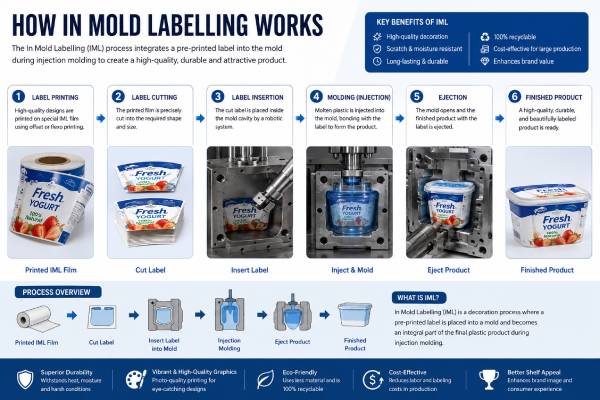
Why Sample Testing Is Important for IML
Every plastic product is different.
Even when two products are described as the same type of plastic, their resin grade, additives, colour, surface finish, shape and moulding conditions may differ.
For this reason, an in mould labelling sample test can help identify potential problems before mass production.
Testing can evaluate:
- Label compatibility
- Print quality
- Position accuracy
- Surface appearance
- Colour consistency
- Durability
- Production feasibility
For industrial projects, testing the actual product is generally more informative than evaluating the application based only on product photographs.
What Information Is Needed for an In Mould Labelling Quote?
To evaluate an IML project and prepare an appropriate quotation, manufacturers should provide as much technical information as possible.
Important information includes:
- Plastic material
For example: PP, PE, PET, HDPE, ABS or another resin. - Product dimensions
Length, width, height, diameter, circumference or other relevant measurements. - Label size
Required label width and height. - Label position
Front, back, side, lid, cap or another specific location. - Product shape
Flat, cylindrical, curved or complex geometry. - Artwork
Logo, graphics, patterns, product information or design files. - Production quantity
Estimated order volume or annual production volume. - Durability requirements
Resistance to moisture, abrasion, chemicals, temperature or other environmental conditions. - Application environment
Indoor, outdoor, food packaging, household use, industrial use or another application. - Actual product sample
A physical sample is recommended whenever possible.
With these details, the technical team can better evaluate the appropriate solution and production requirements.
In Mould Labelling for Plastic Packaging
Plastic packaging manufacturers increasingly require decoration methods that combine product appearance, brand identity and production efficiency.
In mould labelling for plastic packaging can provide an integrated approach to decorating containers, tubs, lids and other injection-moulded products.
The technology can support packaging designs featuring:
- Brand logos
- Product images
- Multi-colour graphics
- Decorative patterns
- Product information
- Visual identification
For packaging manufacturers, the final solution should be selected according to the packaging material, moulding process, label requirements, production volume and target market.
In Mould Labelling Manufacturer in Vietnam
For businesses sourcing plastic packaging decoration or IML-related solutions in Vietnam, technical communication is an important part of the development process.
HDEcal works with customers to evaluate product samples, specifications and decoration requirements before moving toward production.
Depending on the project, support can include:
- Technical consultation
- Product and material evaluation
- Artwork preparation
- Sample development
- Testing
- Production preparation
- Mass-production support
For OEM and ODM projects, providing product samples and technical requirements at the beginning of the project can help shorten the evaluation process and reduce production risks.
Frequently Asked Questions About In Mould Labelling
What does in mould labelling mean?
In mould labelling (IML) is a process in which a pre-printed label is placed inside an injection mould and becomes integrated with a plastic product during the moulding process.
What is IML packaging?
IML packaging refers to plastic packaging products decorated using the in mould labelling process. Typical examples include containers, tubs, lids and other injection-moulded packaging.
Is in mould labelling suitable for all plastics?
Not necessarily. Suitability depends on the plastic resin, label construction, product geometry, mould design and processing conditions. Testing is recommended before mass production.
What products can use IML?
Potential applications include food containers, household packaging, cosmetic packaging, storage products, lids, tubs and selected industrial plastic products.
Is IML suitable for large production volumes?
IML can be suitable for high-volume injection moulding because label handling and moulding can be integrated into an automated production process.
Can IML support detailed graphics?
Yes. IML can be used for detailed logos, images, patterns, product information and other graphic elements, depending on the printing and label system selected.
How do I start an IML project?
Start by providing the actual product sample or detailed product information, including plastic material, dimensions, label area, artwork, production quantity and durability requirements. The technical team can then evaluate the application and develop a sample.
Get an In Mould Labelling Solution for Your Product
Choosing the right in mould labelling solution requires more than selecting a label.
The plastic material, product geometry, mould, label construction, artwork and production conditions all need to work together to achieve a consistent result.
HDEcal can support manufacturers through product evaluation, technical consultation, sample development, testing and production preparation.
If you are developing a new plastic product or looking for an in mould labelling solution in Vietnam, send us your product sample and technical requirements for evaluation.
Contact HDEcal for technical consultation, sample development and production quotation.
Contact Hyuntech Today
If you are looking for a reliable partner for In Mold Labelling solutions, Hyuntech is ready to support your business with high-quality products, competitive pricing, and expert consultation.
Contact Hyuntech now to get a customized IML solution and maximize your production efficiency.
———————————-
HYUN-TECH HOLDINGS., JSC
Office: Facility 1: Lot BT11, Eurowindow River Park Urban Area, Đông Anh, Hà Nội, Vietnam
Factory: 312 Nguyễn Văn Linh, Đường Hào, Hưng Yên
Heat Transfer Processing Workshop: Thôn Đoài, Vĩnh Thanh, Hà Nội
Hotline: 0332.837.260 – 08888.1.3333
Bài viết cùng chủ đề
-
 Heat Transfer Printing on Household Products
-
 Plastic Packaging Printing Methods: Full Guide
-
 Packaging Solutions for Global Brands: Standards & Innovation
-
 Custom Heat Transfer Film Manufacturer Vietnam | OEM
-
 In Mould Labeling Explained: Why Brands Are Switching
-
 Heat Transfer Film for Cosmetic Packaging Design