
IML Packaging for Food Industry
In today’s competitive food market, packaging is no longer just a container—it is a powerful branding and protection tool. Businesses are increasingly shifting toward IML packaging for food industry to achieve better durability, higher visual appeal, and optimized production efficiency.
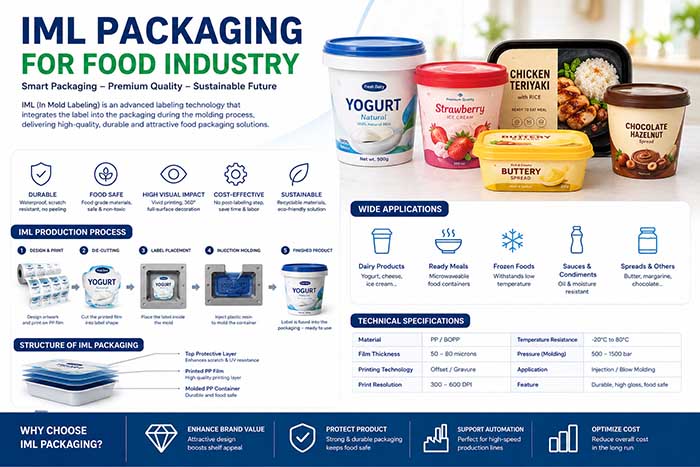
IML (In-Mold Labeling) is revolutionizing plastic food packaging printing by embedding the label directly into the packaging during manufacturing, eliminating the need for post-labeling processes.
IML packaging for food industry
What is In Mold Labeling Food Packaging?
In mold labeling food packaging is a process where a pre-printed label is placed inside a mold, and molten plastic is injected to fuse the label and container into one seamless unit.
This creates:
- A scratch-resistant surface
- A fully integrated label
- A high-end packaging finish
Unlike traditional food container labeling, IML ensures that the label becomes a permanent part of the packaging.
Key Benefits of IML Packaging for Food Industry
1. Long-Lasting & Durable Food Packaging
- Resistant to moisture, oil, and chemicals
- Withstands temperatures from -20°C to 80°C
- No peeling, cracking, or fading
This makes it ideal for frozen foods, dairy products, and ready meals.
2. Premium Branding & Shelf Impact
- High-definition printing (300–600 DPI)
- Supports metallic, matte, and glossy finishes
- 360° full-surface decoration
Brands can stand out on crowded shelves with visually appealing packaging.
3. Hygienic & Food-Safe Solution
- Uses certified food-grade materials
- No glue or adhesives required
- Reduced contamination risks
This is especially critical for export-oriented food businesses.
4. Cost Optimization at Scale
- Eliminates secondary labeling steps
- Reduces labor costs by up to 30%
- Improves production efficiency
Over time, IML packaging solutions significantly lower total operating costs.
IML Packaging Production Process
[IMAGE SUGGESTION: Step-by-step IML process diagram]
Step 1: Artwork & Film Printing
- Materials: BOPP / PP film
- Thickness: 50–80 microns
Step 2: Label Die-Cutting
- Precision cutting ensures perfect mold fit
- Accuracy tolerance: ±0.1 mm
Step 3: Automated Label Placement
- Robotic arms place labels inside molds
- Ensures consistent positioning
Step 4: Injection Molding
- Temperature range: 180–250°C
- Pressure: 500–1500 bar
Step 5: Final Output
- Label and container become one
- No need for additional labeling
Real-World Applications in Food Industry
[IMAGE SUGGESTION: food packaging applications]
Dairy Packaging
- Yogurt cups, butter containers
- Maintains quality in cold storage
Frozen Food Packaging
- Durable in sub-zero environments
- No label damage during transport
Ready-to-Eat Meals
- Microwave-safe containers
- Clear nutritional information printing
Sauces & Condiments
- Oil-resistant surface
- Long-lasting branding
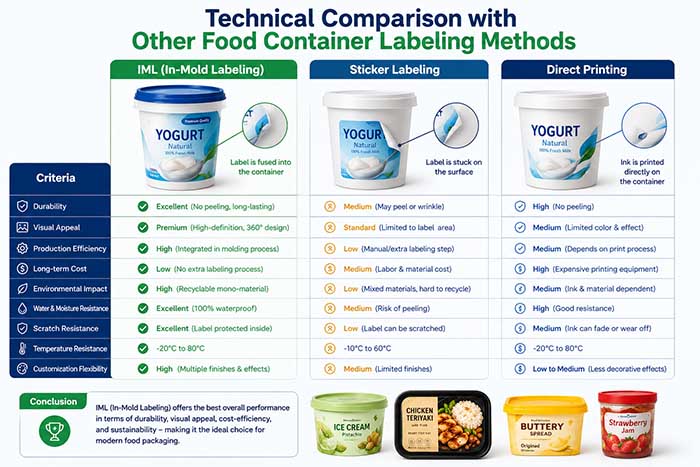
Technical Comparison with Other Food Container Labeling Methods
| Feature | IML Packaging | Sticker Labeling | Direct Printing |
|---|---|---|---|
| Durability | Excellent | Medium | High |
| Visual Appeal | Premium | Standard | Medium |
| Production Efficiency | High | Low | Medium |
| Long-term Cost | Low | Medium | High |
| Environmental Impact | Recyclable | Mixed materials | Moderate |
Technical Comparison with Other Food Container Labeling Methods
Technical Specifications of IML Packaging Solutions
| Parameter | Specification |
|---|---|
| Film Type | PP / BOPP |
| Thickness | 50–80 microns |
| Print Quality | 300–600 DPI |
| Temperature Resistance | -20°C to 80°C |
| Bonding Method | Fusion (no adhesive) |
| Lifespan | 5+ years |
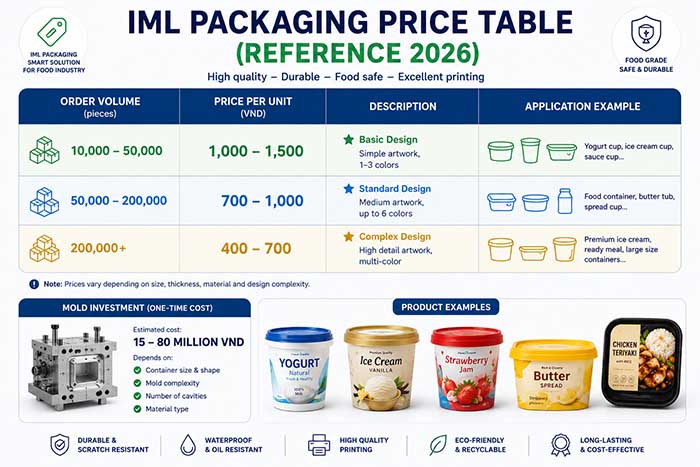
IML Packaging Price Table (Reference 2026)
Prices depend on volume and design complexity
| Order Volume | Price per Unit (VND) | Description |
|---|---|---|
| 10,000 – 50,000 | 1,000 – 1,500 | Basic design |
| 50,000 – 200,000 | 700 – 1,000 | Standard |
| 200,000+ | 400 – 700 | Bulk production |
Mold Investment:
- Estimated: 15 – 80 million VND
IML Packaging Price Table (Reference 2026)
Industry Trends Driving IML Adoption
- Increasing demand for durable food packaging
- Shift toward sustainable mono-material packaging
- Growth of automated manufacturing systems
- Integration of smart packaging (QR codes, traceability)
Global brands are rapidly adopting IML packaging for food industry to stay competitive and meet environmental regulations.
Why Hyuntech is the Right Partner for IML Packaging
With nearly a decade of experience, Hyuntech has become a trusted supplier of IML packaging solutions for food manufacturers in Vietnam and international markets.
What Makes Hyuntech Stand Out?
- Advanced printing systems (offset & gravure)
- Strict compliance with food safety standards
- High production capacity: 10 million+ units/month
- Fast lead time: 7–15 days
- Dedicated technical consulting team
Value You Get:
- Optimized design for cost savings
- Consistent high-quality output
- Scalable production for large orders
Final Thoughts
IML packaging for food industry is transforming how food products are packaged, presented, and protected. With unmatched durability, premium aesthetics, and cost efficiency, it offers a future-proof solution for modern food businesses.
If your brand is aiming to:
- Improve product packaging quality
- Reduce long-term production costs
- Enhance brand visibility
👉 Hyuntech is ready to support you with tailored IML packaging solutions.
CTA:
📞 Contact Hyuntech today to get a free consultation, design support, and sample testing for your food packaging project!
Read more:
Bài viết cùng chủ đề
-
 What Is Heat Transfer Film? A Complete Guide for Manufacturers
-
 Heat Transfer Film for Plastic Packaging: Applications & Benefits
-
 In logo lên chai thủy tinh nên bắt đầu từ đâu?
-
 Heat Transfer Film for Bottles – Durable Printing
-
 What Is Heat Transfer Printing?
-
 Advantages of In Mould Labeling for Packaging