Heat Transfer Printing on Plastic Housings | Hyuntech
Meta Title: Heat Transfer Printing on Plastic Housings
Meta Description: Discover heat transfer printing on plastic housings, including materials, specifications, pricing, applications, and custom printing solutions by Hyuntech.
Heat Transfer Printing on Plastic Housings: Custom Solutions by Hyuntech
Heat transfer printing on plastic housings is an effective surface decoration solution for manufacturers looking to enhance the appearance, branding, and functionality of plastic components. This technology can be used to apply logos, patterns, product labels, decorative textures, and customized graphics to compatible plastic enclosures used in electronics, home appliances, automotive components, industrial equipment, and consumer products.
For businesses developing branded plastic products, selecting the right heat transfer printing process is essential to achieving consistent appearance, reliable adhesion, and efficient mass production.
Hyuntech can be contacted to discuss customized plastic housing decoration projects, material compatibility, production requirements, and OEM/ODM opportunities. Whether you are sourcing printed electronic enclosures, appliance panels, or decorative plastic covers, understanding the technical specifications and cost factors will help you make informed purchasing decisions.
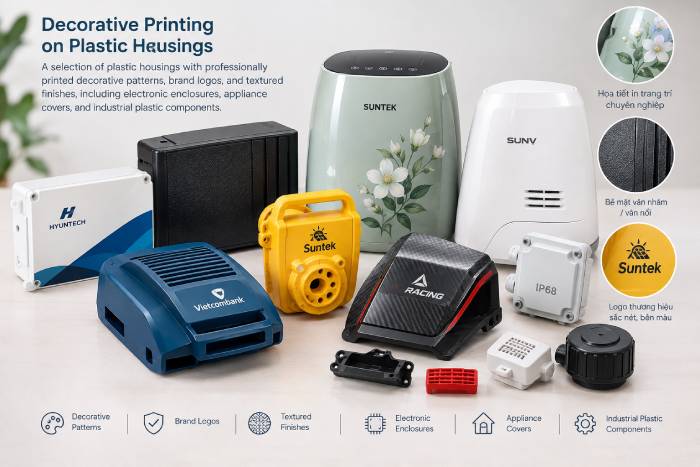
What Is Heat Transfer Printing on Plastic Housings?
Heat transfer printing on plastic housings is a decoration process that uses controlled heat and pressure to transfer a printed design from a carrier film or transfer medium onto a compatible plastic surface.
Depending on the production system, this process may use heat transfer films, specialty transfer foils, or related thermal decoration technologies. The appropriate method depends on the plastic resin, housing geometry, surface finish, design requirements, and expected product service life.
Compared with applying conventional adhesive labels, heat transfer printing can provide a more integrated decorative appearance and support repeatable branding across production batches.
However, not all plastics respond equally to heat and pressure. Material compatibility testing is necessary to prevent deformation, discoloration, poor adhesion, or damage to the housing.
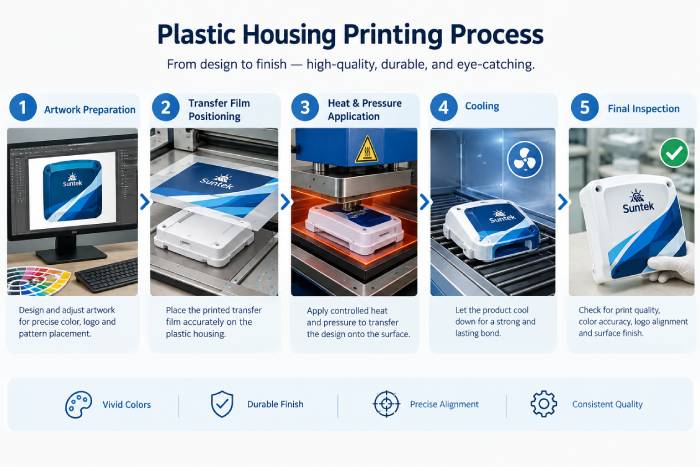
How Does Heat Transfer Printing on Plastic Housings Work?
The production process generally includes the following stages.
Artwork preparation: The customer provides a logo, pattern, or graphic design. Vector formats such as AI, EPS, SVG, and print-ready PDF are suitable for many applications.
Transfer film preparation: The design is printed or prepared on a compatible transfer medium using the selected ink and decoration system.
Plastic surface preparation: The housing is cleaned and inspected. Some materials may require surface treatment or a specially formulated primer.
Heat and pressure application: The transfer medium is positioned on the plastic housing, and controlled heat and pressure are applied according to the process specifications.
Cooling and finishing: The decorated component is cooled and inspected. Any additional curing or finishing follows the requirements of the selected material system.
Quality inspection: The finished housing is checked for color consistency, pattern alignment, adhesion, scratches, and surface defects.
The precise operating conditions must be established through material trials and equipment validation. A single temperature or pressure setting cannot be applied safely to every plastic housing.
Heat Transfer Printing Methods for Plastic Enclosures
Several decoration technologies can be considered for plastic housings. The best option depends on the component’s geometry, resin type, visual requirements, and production volume.
Heat Transfer Film Printing on Plastic Housings
Heat transfer film printing uses a specially prepared film to transfer a decorative layer onto a compatible plastic surface.
It can be considered for selected flat or moderately curved components, including appliance covers, plastic panels, control housings, and consumer product enclosures.
Advantages may include repeatable patterns, attractive decorative finishes, and suitability for certain automated or semi-automated production processes.
The film, adhesive layer, temperature, and pressure must be compatible with the plastic resin and surface geometry.
Heat Transfer Foil Decoration for Plastic Enclosures
Heat transfer foil decoration can produce metallic, glossy, or specialty visual effects on compatible plastic components.
Common applications include cosmetic packaging, consumer electronics, decorative trim, appliance panels, and branded product housings.
The final appearance depends on the foil system, surface preparation, substrate, and application equipment. Buyers should request samples to verify the intended finish before approving production.
Heat Transfer Printing vs. Water Transfer Printing
Water transfer printing uses a water-soluble carrier film to transfer decorative patterns onto compatible three-dimensional objects.
It may be suitable for complex curves and decorative patterns where conventional flat transfer systems are difficult to apply.
Heat transfer printing is generally more dependent on controlled thermal contact and the geometry of the transfer area, while water transfer printing may offer greater flexibility for certain complex shapes.
Heat Transfer Printing vs. UV Printing on Plastic
UV printing uses ultraviolet-curable inks to create graphics directly on compatible surfaces.
It can be useful for detailed logos, variable artwork, prototypes, and customized components. Heat transfer methods may be more suitable for selected repeat patterns or specialty decorative finishes.
The correct choice should be based on appearance, adhesion, production speed, durability requirements, and total manufacturing cost.
| Printing method | Typical application | Main advantages | Important considerations |
|---|---|---|---|
| Heat transfer film printing | Compatible plastic covers and panels | Repeatable decorative patterns | Requires thermal and material compatibility |
| Heat transfer foil decoration | Decorative trim and branded enclosures | Metallic and specialty finishes | Finish depends on foil and substrate |
| Water transfer printing | Complex three-dimensional surfaces | Flexible decorative patterns | Requires suitable film and finishing process |
| UV printing | Logos, labels, and detailed graphics | Flexible artwork and short runs | Adhesion depends on resin and surface treatment |
| Pad printing | Small logos and curved surfaces | Suitable for selected small components | Print area and artwork are limited by tooling |
| Screen printing | Flat panels and repeat graphics | Effective for selected high-volume jobs | Setup and geometry can limit flexibility |
Technical Specifications for Heat Transfer Printing on Plastic Housings
Technical specifications help manufacturers evaluate production feasibility, quality requirements, and project costs.
The following figures are indicative planning values for discussing a custom plastic housing project. They are not verified Hyuntech equipment specifications or guaranteed production capabilities. Final parameters depend on the selected resin, transfer material, machinery, and part design.
Plastic Housing Printing Specifications
| Specification | Indicative planning value | Notes |
|---|---|---|
| Plastic materials | ABS, PC, PC/ABS, selected PP grades | Confirm compatibility with the transfer system |
| Component size | Approximately 30–300 mm | Illustrative range, not a machine limit |
| Decoration area | Approximately 10–200 mm | Depends on component geometry |
| Artwork resolution | 300 DPI at final size | Suitable for many raster graphics |
| Artwork formats | AI, EPS, SVG, PDF, PNG | Vector artwork is preferred for logos |
| Print colors | Single color to multicolor | Depends on the decoration technology |
| Sample development | Approximately 3–10 business days | Planning estimate |
| Production lead time | Approximately 10–25 business days | Subject to tooling, quantity, and approval |
| Quality inspection | Visual checks and adhesion testing | Additional tests depend on application |
| Packaging | Individual bags, trays, or bulk cartons | Based on component protection requirements |
Which Plastic Materials Are Suitable for Heat Transfer Printing?
Material selection is critical because different polymers respond differently to heat, pressure, coatings, and adhesives.
ABS plastic: Commonly used for electronic enclosures, appliance housings, and consumer products. Suitability depends on the specific grade, surface finish, and transfer system.
Polycarbonate (PC): Used for durable enclosures and transparent or translucent components. Thermal limits and surface compatibility must be checked.
PC/ABS blends: Used in selected electronic and industrial housings. Testing is necessary because blend composition and additives can affect transfer performance.
Polypropylene (PP): Often presents adhesion challenges because of its relatively low surface energy. A compatible transfer system or appropriate surface treatment may be required.
Polyethylene (PE): Also has low surface energy and can be difficult to decorate with some processes. Compatibility testing is particularly important.
For engineered plastic components, buyers should provide the exact resin grade, any surface coating information, and the operating environment before selecting a printing method.
Heat Transfer Temperature, Pressure, and Processing Time
There is no universal temperature, pressure, or dwell time for heat transfer printing on plastic housings. Excessive heat can deform the component, while insufficient heat or pressure may cause incomplete transfer or poor adhesion.
| Process parameter | What to evaluate | Recommended approach |
|---|---|---|
| Temperature | Resin heat resistance and transfer material requirements | Establish through controlled trials |
| Pressure | Housing rigidity and surface contact | Avoid distortion and uneven contact |
| Dwell time | Transfer completeness and surface stability | Validate for each material system |
| Surface preparation | Contamination, coatings, and surface energy | Follow the selected process requirements |
| Cooling | Dimensional stability and finish quality | Use the specified cooling procedure |
| Adhesion | Resistance to handling and abrasion | Conduct tests appropriate to the intended application |
| Dimensional accuracy | Warping and deformation | Inspect critical dimensions before and after printing |
For housings used in electronics or industrial equipment, printing trials should also consider component tolerances, assembly fit, and potential exposure to heat, cleaning agents, or outdoor conditions.
[Image position: Technical close-up image]
Image description: A close-up of a plastic enclosure positioned in a heat transfer fixture, highlighting precise graphic alignment, controlled processing, and inspection of the finished surface.
Heat Transfer Printing on Plastic Housings: Price Guide
The price of heat transfer printing on plastic housings depends on component size, resin type, decoration area, artwork complexity, order quantity, tooling, quality requirements, and packaging.
The following table provides illustrative budgeting estimates in US dollars. These are not verified current market quotations or official Hyuntech prices. Actual costs may differ significantly depending on the manufacturing location, component complexity, and selected process.
Estimated Heat Transfer Printing Prices
| Order quantity | Indicative decoration cost per piece | Estimated decoration subtotal |
|---|---|---|
| 100–499 pieces | US$0.30–1.20 | US$30–598.80 |
| 500–999 pieces | US$0.20–0.80 | US$100–799.20 |
| 1,000–4,999 pieces | US$0.12–0.55 | US$120–2,749.45 |
| 5,000–9,999 pieces | US$0.08–0.35 | US$400–3,499.65 |
| 10,000 pieces or more | US$0.05–0.25 | From US$500, depending on quantity |
These estimates cover illustrative decoration costs only. They do not necessarily include the plastic housing itself, mold development, tooling, surface treatment, printing setup, inspection, packaging, taxes, or transportation.
Additional Costs for Custom Plastic Housing Printing
| Cost item | Pricing considerations |
|---|---|
| Plastic housing | Depends on material, dimensions, wall thickness, and molding process |
| Transfer film or foil | Depends on the material system, color, and consumption |
| Setup and tooling | Depends on fixture design, equipment, and component geometry |
| Surface treatment | May be required for selected plastics |
| Sampling | Depends on artwork, material availability, and testing requirements |
| Quality testing | Depends on adhesion, abrasion, chemical, and environmental requirements |
| Packaging | Depends on scratch protection and shipment requirements |
| Shipping | Depends on destination, shipment volume, and delivery terms |
How to Reduce Plastic Housing Printing Costs
Optimize the decoration area: Printing only where branding is necessary may reduce material consumption and processing time.
Standardize artwork: Reusing approved artwork across compatible product models can simplify setup and quality control.
Consolidate order quantities: Larger production batches may reduce the allocated setup cost per piece.
Select the right technology: A process that works well for flat panels may not be suitable for deep curves or complex geometries.
Approve samples before mass production: Early testing can reduce the risk of defective batches, rework, and delayed delivery.
For an accurate quotation, Hyuntech should be provided with the component drawing, resin specification, artwork, expected quantity, and required delivery schedule.
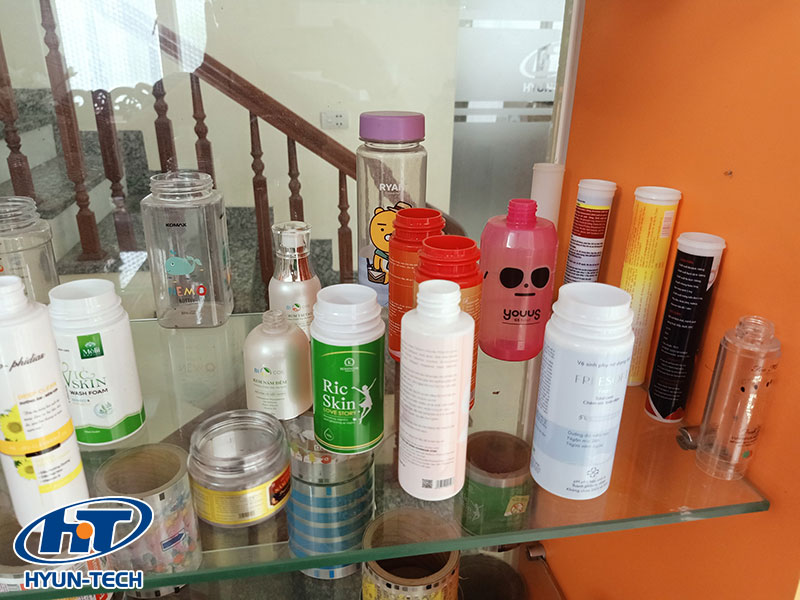
Applications of Heat Transfer Printing on Plastic Housings
Customized plastic housings are widely used across industries where appearance, branding, and component identification are important.
Electronic Device Enclosures
Plastic housings for controllers, consumer electronics, accessories, and electronic equipment may require decorative graphics, brand logos, or product identification.
Printing specifications should account for assembly tolerances, handling, and exposure to heat during normal product use.
Home Appliance Plastic Covers
Appliance panels, control housings, and decorative covers may use printed patterns, product logos, or specialty finishes to create a consistent product design.
The selected decoration must be compatible with the appliance’s expected operating temperature, cleaning procedures, and service environment.
Automotive Plastic Components
Interior trim, decorative covers, and selected automotive plastic components may require printed textures, metallic effects, or branded graphics.
Automotive applications often require more extensive testing for abrasion, temperature changes, chemical exposure, and long-term durability. Applicable customer and industry requirements should be established before production.
Industrial Equipment Housings
Industrial control panels, equipment enclosures, and machine covers may require durable graphics, identification marks, or decorative surfaces.
For industrial applications, the printing system should be evaluated against the expected exposure to oils, cleaning chemicals, abrasion, and environmental conditions.
Consumer Products and Branded Packaging
Small appliances, personal care devices, cosmetic packaging, and other consumer products can benefit from customized plastic housing decoration.
Heat transfer printing or related decoration technologies may help brands achieve distinctive finishes and consistent visual identity across product ranges.
Quality Control for Heat Transfer Printing on Plastic Housings
A structured quality control process helps reduce appearance defects and improve manufacturing consistency.
Visual Inspection and Print Alignment
Inspectors should check logo positioning, pattern continuity, color consistency, surface scratches, bubbles, wrinkles, and incomplete transfer.
Critical dimensions and assembly interfaces should also be inspected when thermal processing could affect the component.
Adhesion and Abrasion Testing
The appropriate adhesion test depends on the decoration system and customer requirements. Cross-cut adhesion testing may be relevant for certain coatings, while other transfer systems require different evaluation methods.
Abrasion testing can help assess resistance to rubbing and repeated handling.
Testing should use agreed acceptance criteria rather than relying on an informal visual check alone.
Environmental and Chemical Resistance
For components exposed to heat, sunlight, humidity, cleaning products, or industrial chemicals, additional testing may be required.
The test conditions should reflect the product’s real operating environment and the relevant customer specifications.
Quality Inspection Checklist
| Quality factor | Inspection objective |
|---|---|
| Print alignment | Verify the design position against approved drawings |
| Color consistency | Compare with approved samples or color standards |
| Surface appearance | Identify scratches, bubbles, wrinkles, and incomplete transfer |
| Adhesion | Verify that the decoration meets agreed acceptance criteria |
| Abrasion resistance | Evaluate wear under specified conditions |
| Dimensional stability | Confirm that the housing remains within tolerance |
| Packaging | Prevent scratches and damage during transport |
| Batch traceability | Maintain records for production and quality investigations |
Why Choose Hyuntech for Plastic Housing Printing Projects?
When sourcing heat transfer printing on plastic housings, businesses need a supplier that can evaluate technical requirements, communicate production limitations, and support the development of a suitable decoration solution.
Hyuntech can be contacted to discuss plastic component printing projects and determine which services and production options are available for your requirements.
Customized Decoration for Different Plastic Components
Each plastic housing may require a different combination of material preparation, transfer technology, artwork positioning, and finishing.
Providing a technical drawing and resin specification helps the supplier assess whether the desired decoration is feasible and whether an alternative process may be more appropriate.
OEM and ODM Project Coordination
Businesses developing branded products may need customized designs, component decoration, packaging, or coordination between product development and manufacturing.
OEM and ODM services, including custom development and production support, should be confirmed directly with Hyuntech according to the project scope and available capabilities.
Production Quality and Technical Evaluation
Before mass production, establish clear requirements for artwork, color, print location, adhesion, abrasion resistance, dimensional accuracy, and packaging.
Ask Hyuntech to confirm its available printing processes, sample development procedures, production capacity, testing capabilities, and lead times.
This approach supports more transparent communication and helps reduce the risk of selecting an unsuitable printing technology.
Request a Quote for Heat Transfer Printing on Plastic Housings from Hyuntech
Looking for a customized printing solution for plastic enclosures, electronic housings, appliance covers, or industrial components?
Contact Hyuntech to discuss your plastic housing decoration requirements and evaluate the most suitable production approach.
For a faster quotation, prepare the following information:
- Plastic material and resin grade.
- Component drawings or 3D files.
- Housing dimensions and decoration area.
- Logo or artwork in a high-resolution format.
- Expected order quantity and annual demand.
- Required surface finish and color specifications.
- Adhesion, abrasion, temperature, and chemical resistance requirements.
- Packaging, delivery destination, and target delivery date.
Hyuntech can then review the project requirements and confirm the available options, quotation, sample process, and production schedule.
Contact Hyuntech today to discuss your heat transfer printing on plastic housings project and request a customized quotation.
Frequently Asked Questions About Heat Transfer Printing on Plastic Housings
What is heat transfer printing on plastic housings?
Heat transfer printing is a surface decoration process that uses heat and pressure to transfer a printed design onto a compatible plastic component. The process can be used for selected logos, patterns, textures, and decorative finishes.
Which plastics are suitable for heat transfer printing?
ABS, polycarbonate, PC/ABS, and selected grades of polypropylene may be compatible with particular transfer systems. Suitability depends on the exact resin grade, surface condition, transfer material, and processing conditions.
How much does heat transfer printing on plastic housings cost?
The price depends on component size, printing area, artwork, order quantity, tooling, and testing requirements. Illustrative decoration estimates range from approximately US$0.05 to US$1.20 per piece, but the actual quotation must be confirmed with the supplier.
Is heat transfer printing durable on plastic enclosures?
Durability depends on the transfer system, material compatibility, surface preparation, and operating environment. Adhesion, abrasion, temperature, and chemical resistance should be tested when relevant to the product’s intended use.
How can I request a quotation from Hyuntech?
Prepare the plastic housing drawings, resin specification, artwork, order quantity, required finish, testing requirements, and delivery information. Contact Hyuntech to confirm the available printing technology, sample requirements, production schedule, and final price.