Heat Transfer Printing on Metal Bottles | Hyuntech
Heat transfer printing on metal bottles is a decorative printing solution for applying logos, colorful graphics, patterns, and customized branding to metal drinkware and reusable bottles. It helps manufacturers create distinctive products for promotional campaigns, corporate gifts, retail brands, and private-label collections.
Compared with conventional decoration methods, heat transfer printing can offer flexibility in artwork and design. However, the final result depends on the bottle material, surface coating, transfer film, equipment, and production conditions.
For manufacturers seeking heat transfer printing on metal bottles, choosing a compatible transfer system is essential for achieving consistent colors, good adhesion, and a durable finish. Hyuntech provides heat transfer film solutions and industrial printing services for businesses looking to develop customized products.
Read more:
Heat Transfer Printing on Wood | HyunTech
Heat Transfer Printing on Glass Cups | Hyuntech
Heat Transfer Printing on Plastic Housings | Hyuntech
Heat Transfer Printing on Plastic Bottles | HyunTech
Heat Transfer Printing on Plastic Caps | Hyuntech
Heat Transfer Printing on Plastic Cups | Hyuntech
Heat Transfer Printing on Plastic Trays | Hyuntech
Heat Transfer Printing on Plastic Containers | Hyuntech
Heat Transfer Printing on Plastic Parts | Hyuntech
Heat Transfer Printing on Plastic Toys | Hyuntech
Heat Transfer Printing on Metal Boxes | Hyuntech
Heat Transfer Printing on Metal Bottles | Hyuntech
Heat Transfer Printing on Metal Utensils | HyunTech
Heat Transfer Printing on Glass Bottles | HyunTech
Heat Transfer Printing on Glass Jars | HyunTech
What Is Heat Transfer Printing on Metal Bottles?
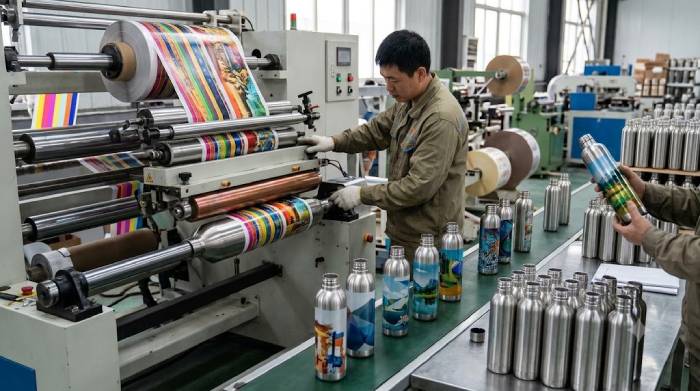
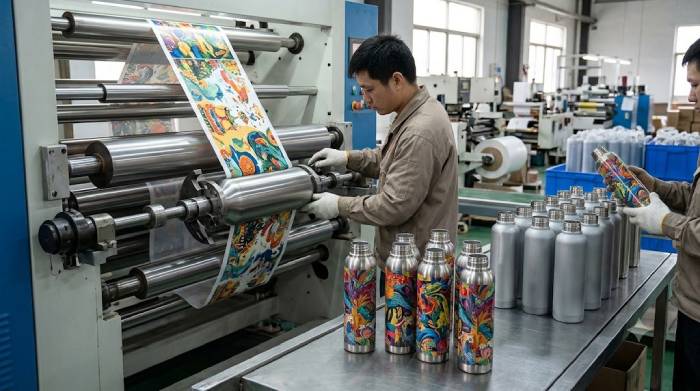
Heat transfer printing on metal bottles is a process that transfers a pre-printed design from a carrier film onto a compatible bottle surface using controlled heat, pressure, and a suitable transfer system.
The technology may be considered for stainless steel bottles, aluminum bottles, coated metal drinkware, and selected reusable containers. Suitability varies according to the surface treatment, bottle geometry, and the transfer materials used.
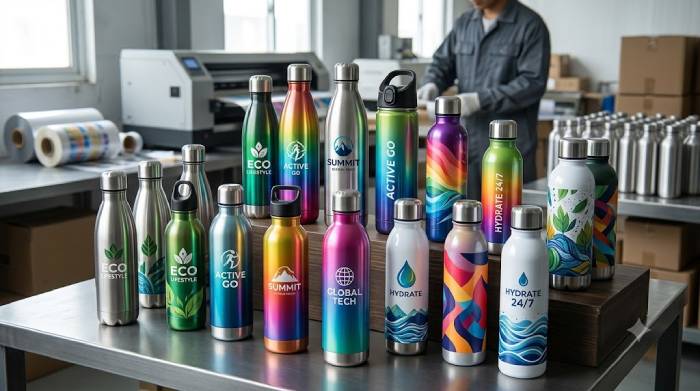
Common designs include company logos, product graphics, full-color patterns, decorative illustrations, and personalized branding.
How Does Heat Transfer Printing on Metal Bottles Work?
The process typically includes the following stages:
- Bottle inspection: Identify the metal substrate, coating, shape, and surface condition.
- Surface preparation: Clean the bottle and verify that the surface is compatible with the selected transfer system.
- Artwork preparation: Prepare the design, colors, logo, and print dimensions.
- Transfer film selection: Choose a suitable film and ink system for the bottle’s surface finish.
- Heat transfer application: Apply the required temperature, pressure, and contact time according to the material specifications.
- Cooling and film removal: Follow the process requirements to reveal the transferred design.
- Quality inspection: Check color accuracy, graphic alignment, adhesion, and surface defects.
The appropriate process may differ for straight-sided bottles, tapered bottles, curved surfaces, and bottles with textured or powder-coated finishes. A sample trial should be completed before mass production.
Benefits of Heat Transfer Printing for Metal Bottles
Metal bottles are popular in reusable drinkware, corporate merchandise, and promotional product manufacturing. Their rigid structure and reusable design make them suitable for a variety of branding applications.
Detailed Graphics and Customized Bottle Designs
Heat transfer printing can support multicolor artwork and decorative designs when the film, ink system, and substrate are compatible.
Potential applications include:
- Corporate logos and branded drinkware
- Full-color illustrations and decorative patterns
- Personalized names and promotional graphics
- Event merchandise and limited-edition collections
- Private-label reusable bottles
- Customized gifts for employees and business partners
The achievable print resolution, color range, and coverage depend on the selected materials and production process.
Consistent Branding Across Production Batches
Manufacturers often need hundreds or thousands of bottles with consistent logos, colors, and artwork placement. Standardized artwork files, approved samples, and controlled production parameters help improve repeatability.
For larger orders, manufacturers should establish color references, acceptable defect limits, and inspection procedures before production begins.
Flexible Decoration for Different Bottle Styles
Heat transfer printing may be evaluated for different metal bottle designs, including straight cylindrical bottles and selected curved or tapered models.
However, surface curvature, bottle dimensions, coating composition, and the available transfer equipment affect the final result. Not every transfer system can cover every bottle shape uniformly.
Which Metal Bottles Are Suitable for Heat Transfer Printing?
The metal substrate and surface finish are two of the most important factors when selecting a printing solution.
| Bottle material or finish | Typical applications | Key considerations |
|---|---|---|
| Stainless steel | Reusable water bottles, insulated drinkware | Coating compatibility, surface curvature, and heat tolerance |
| Aluminum | Lightweight drink bottles and promotional containers | Surface treatment, protective coating, and transfer adhesion |
| Powder-coated metal | Colored reusable bottles and branded merchandise | Coating composition, curing resistance, and surface condition |
| Painted metal | Promotional bottles and decorative containers | Paint adhesion and resistance to transfer conditions |
| Lacquered metal | Specialty containers and selected metal bottles | Lacquer compatibility and temperature limitations |
Heat Transfer Printing on Stainless Steel Bottles
Stainless steel bottles are widely used in reusable drinkware. Their surfaces may be bare, brushed, polished, painted, or powder-coated.
These finishes have different surface characteristics, so the transfer material must be selected for the actual bottle finish rather than stainless steel alone.
Heat Transfer Printing on Aluminum Bottles
Aluminum bottles are lightweight and can be used for promotional products and specialty packaging. The oxide layer, surface treatment, and protective coating can influence transfer performance.
Before choosing a film, manufacturers should confirm the substrate specifications and test the proposed process on the finished bottle.
Heat Transfer Printing vs. Other Metal Bottle Printing Methods
Heat transfer printing is not the only option for decorating metal bottles. Direct printing, screen printing, laser marking, and other processes may be more suitable depending on the artwork, quantity, surface, and durability requirements.
| Printing method | Main advantages | Limitations | Suitable applications |
|---|---|---|---|
| Heat transfer printing | Flexible graphics and decorative designs | Requires compatible films, coatings, and processing conditions | Customized bottle designs and multicolor graphics |
| Screen printing | Suitable for repeat logos and selected color designs | Complex artwork may require additional screens and setup | Corporate branding and promotional bottles |
| UV direct printing | Digital artwork flexibility and short-run customization | Adhesion and durability depend on the ink and surface | Personalized bottles and limited runs |
| Laser marking | Precise, permanent marking on compatible surfaces | Typically not suitable for full-color photographic graphics | Serial numbers, logos, and minimalist branding |
| Sublimation | Can produce full-color designs on specially prepared substrates | Requires a suitable polymer coating or compatible surface system | Coated metal drinkware designed for sublimation |
Which Bottle Printing Method Should Manufacturers Choose?
Heat transfer printing may be worth evaluating when the design requires decorative graphics and the bottle surface is compatible with the selected transfer system.
Screen printing may be practical for simpler logos, while UV printing can provide flexibility for digital artwork. Laser marking is often considered when permanent, non-color marking is the priority.
Sublimation should not be confused with every type of heat transfer printing: it generally requires a specially prepared surface that can accept sublimation dyes.
The best method should be selected after reviewing the bottle specifications, design requirements, production volume, and sample test results.
Heat Transfer Printing on Metal Bottles: Technical Parameters and Quality Control
Achieving consistent results requires careful control of the transfer film, bottle coating, application conditions, and inspection process. The exact operating parameters must be established through material specifications and production trials.
Key Parameters for Metal Bottle Heat Transfer Printing
| Parameter | What to evaluate | Expected objective |
|---|---|---|
| Transfer temperature | Recommended temperature range for the film and bottle coating | Avoid incomplete transfer or coating damage |
| Application pressure | Uniform contact between film and bottle surface | Minimize gaps and inconsistent coverage |
| Contact time | Dwell time required by the transfer system | Achieve repeatable transfer quality |
| Bottle surface | Coating, cleanliness, and surface condition | Support consistent adhesion |
| Film compatibility | Compatibility with the bottle material and finish | Reduce peeling and transfer defects |
| Bottle geometry | Diameter, taper, curvature, and printable area | Ensure uniform contact across the design |
| Cooling conditions | Cooling requirements specified for the materials | Maintain the intended finish during film removal |
These parameters should not be treated as universal settings. The correct temperature, pressure, and contact time must be confirmed for each combination of film, coating, and equipment.
Quality Tests for Printed Metal Bottles
Quality testing helps manufacturers assess whether decorated bottles meet their appearance and durability requirements.
| Test | Purpose |
|---|---|
| Visual inspection | Identify scratches, bubbles, wrinkles, and missing graphics |
| Adhesion testing | Assess whether the transferred design remains attached |
| Abrasion resistance | Evaluate resistance to rubbing during handling |
| Water and humidity exposure | Assess performance under specified moisture conditions |
| Color consistency | Compare colors against the approved reference sample |
| Batch inspection | Verify print positioning and repeatability across production |
For reusable drinkware, additional testing may be necessary depending on the intended use. If the decorated bottle is intended for food or beverage contact, the complete product must meet the applicable requirements. A decorative printing process alone does not establish food-contact safety.
Heat Transfer Printing on Metal Bottles: Price and Cost Factors
The price of heat transfer printing on metal bottles varies according to the bottle material, surface finish, artwork, printing area, order quantity, and production method.
Because different bottles may require different transfer films and processing conditions, an accurate quotation should be based on the actual product specifications.
Estimated Cost Breakdown for Metal Bottle Printing
The following table identifies the main quotation components. It is a cost-planning guide, not an official Hyuntech price list.
| Cost component | Factors affecting the price |
|---|---|
| Heat transfer film | Film specification, design, and material compatibility |
| Artwork preparation | Design complexity and print-ready file availability |
| Sample production | Number of samples and process adjustments |
| Equipment setup | Fixtures, setup time, and bottle geometry |
| Printing or transfer processing | Printable area, production quantity, and process efficiency |
| Quality inspection | Required appearance and durability tests |
| Packaging and delivery | Packing requirements, destination, and shipping method |
How Order Quantity Affects Metal Bottle Printing Costs
Production volume can influence the unit cost because setup and preparation expenses may be distributed across more products. Actual savings depend on the manufacturing process, artwork, material consumption, and order conditions.
| Order type | Main consideration | Recommended next step |
|---|---|---|
| Prototype | Material compatibility and design feasibility | Request a sample evaluation |
| Small batch | Setup costs and minimum order requirements | Confirm the minimum order quantity |
| Medium batch | Film consumption and production efficiency | Request a quotation based on approved artwork |
| Large batch | Production capacity and batch consistency | Confirm quality standards and delivery schedule |
To obtain a project-specific quotation from Hyuntech, provide the bottle material, dimensions, surface finish, artwork, expected quantity, and required durability.
Why Choose Hyuntech for Heat Transfer Printing on Metal Bottles?
Hyuntech specializes in heat transfer film solutions and industrial printing applications. For manufacturers developing customized metal bottles, selecting a compatible film and validating the production process are important steps toward achieving the required appearance and performance.
Visit the official website: https://hyuntech.com.vn/
Heat Transfer Film Solutions for Metal Surfaces
The appropriate heat transfer film depends on the bottle’s substrate, surface coating, geometry, and decorative requirements.
A film suitable for one coated metal product may not perform identically on a different surface. Manufacturers should therefore provide the actual bottle specifications and arrange compatibility testing before committing to large-scale production.
Customized Printing Solutions for Different Bottle Designs
Metal bottles may have straight, tapered, curved, polished, painted, or powder-coated surfaces. These differences can affect transfer quality and manufacturing efficiency.
Evaluating the product before production helps identify potential challenges involving surface adhesion, graphic positioning, coverage, and coating resistance.
Support for Industrial Manufacturing Projects
For businesses purchasing heat transfer film or developing customized metal bottle products, early technical evaluation can help reduce production risks.
Hyuntech can be contacted to discuss the material requirements, artwork, sample testing, and quotation process for your project.
Contact Hyuntech for Heat Transfer Printing on Metal Bottles
Are you looking for a suitable heat transfer film for stainless steel bottles, aluminum bottles, or other coated metal drinkware?
Hyuntech can discuss your requirements and help evaluate a suitable solution based on the substrate, surface finish, graphic design, production volume, and intended application.
To make the consultation more efficient, prepare the following information:
- Bottle material: Stainless steel, aluminum, or another metal.
- Surface finish: Polished, painted, powder-coated, or otherwise treated.
- Bottle dimensions: Height, diameter, shape, and printable area.
- Artwork: Logo, illustration, pattern, or print-ready design file.
- Order quantity: Sample requirements and estimated production volume.
- Performance requirements: Adhesion, abrasion resistance, moisture exposure, and other relevant conditions.
HyunTech – Heat Transfer Films & Industrial Printing Solutions
Hotline: 0332 837 260 – 088.881.3333
Email: contact@hyuntech.com.vn
Office: Lot BT11, Eurowindow River Park Urban Area, Dong Hoi, Dong Anh, Hanoi, Vietnam
Factory: 312 Nguyen Van Linh, Hung Yen, Vietnam
Website: https://hyuntech.com.vn/
Discuss your project with the Hyuntech team to evaluate material compatibility, arrange sample testing, and request a quotation tailored to your metal bottle printing requirements.
Frequently Asked Questions About Heat Transfer Printing on Metal Bottles
What is heat transfer printing on metal bottles?
Heat transfer printing on metal bottles is a decoration process that transfers graphics, logos, and patterns from a prepared carrier film onto a compatible metal surface using a suitable transfer system. The result depends on the film, coating, equipment, and processing conditions.
Can heat transfer printing be used on stainless steel bottles?
It may be suitable for stainless steel bottles, depending on whether the surface is bare, polished, painted, or powder-coated. The transfer film must be compatible with the actual surface, and sample testing is recommended before mass production.
How much does heat transfer printing on metal bottles cost?
The cost depends on the bottle dimensions, printing area, artwork complexity, transfer materials, setup requirements, and order quantity. Contact Hyuntech with your specifications to request a quotation for your project.
Is heat transfer printing durable on reusable metal bottles?
Durability depends on the transfer system, surface preparation, coating compatibility, and conditions of use. Adhesion and abrasion testing can help establish whether the printed design meets the intended performance requirements.
Does Hyuntech supply heat transfer film for metal bottles?
Hyuntech provides heat transfer film solutions and industrial printing services. Contact the company through its official website to confirm the availability and suitability of materials for your specific bottle type and printing requirements.
Looking for a heat transfer printing solution for metal bottles? Contact Hyuntech to discuss your application, evaluate compatible materials, and request a project-specific quotation.
Bài viết cùng chủ đề
-
 IML Labelling: Process, Cost 2026 & Top Supplier
-
 Heat Transfer Printing on Stainless Steel | HyunTech
-
 What Is Heat Transfer Printing?
-
 Heat Transfer Printing on Metal Boxes | Hyuntech
-
 Heat Transfer Film for Bottles – Durable Printing
-
 How Heat Transfer Film Works on Plastic Surfaces (Complete Guide 2026)