Heat Transfer Printing on Glass Cups | Hyuntech
Heat transfer printing on glass cups is an effective solution for businesses looking to create customized drinkware with attractive designs, brand logos, promotional messages, and personalized artwork. From corporate gifts and promotional merchandise to retail products and branded glassware, custom printed glass cups help businesses increase brand visibility and create memorable customer experiences.
Hyuntech provides customized printing solutions for businesses seeking professional glass cup decoration, flexible order quantities, consistent production quality, and OEM/ODM manufacturing support. Whether you need clear glass cups, frosted glass mugs, or customized drinkware for your brand, selecting the right printing process is essential for achieving the desired appearance, durability, and production efficiency.
This guide explores heat transfer printing on glass cups, including printing techniques, material compatibility, technical specifications, estimated pricing, customization options, and important considerations when sourcing printed glassware from Hyuntech.
What Is Heat Transfer Printing on Glass Cups?
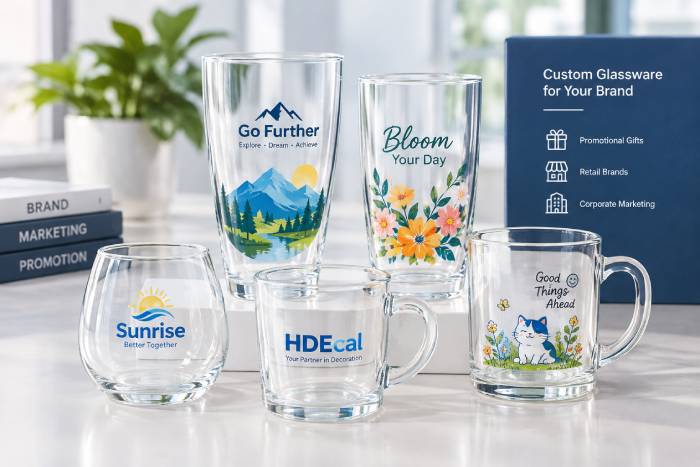
Heat transfer printing on glass cups is a decoration process that uses heat and pressure to transfer a printed design from a transfer medium onto a glass surface. Depending on the ink system, transfer material, coating, and production equipment, the design may be transferred directly or through a specially prepared surface.
Unlike conventional paper labels, professional glass decoration can create a more integrated visual appearance when the appropriate coating and transfer system are used.
The term “heat transfer printing on glass cups” covers several related processes. Not every method is suitable for untreated glass, and selecting the right technology depends on the glass composition, surface treatment, design complexity, and intended use.
How Does Heat Transfer Printing on Glass Cups Work?
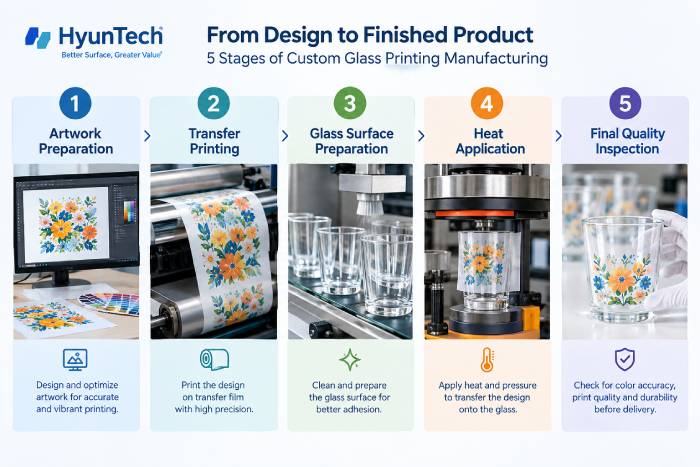
A typical production workflow includes the following stages:
Artwork preparation: The customer supplies a logo, illustration, or other design in a high-resolution format. Vector files such as AI, EPS, or PDF are preferred for logos and text.
Printing the transfer: The design is printed onto a suitable transfer medium using compatible inks.
Glass surface preparation: The glass is cleaned and inspected. Some applications require a specially formulated coating or pretreated surface.
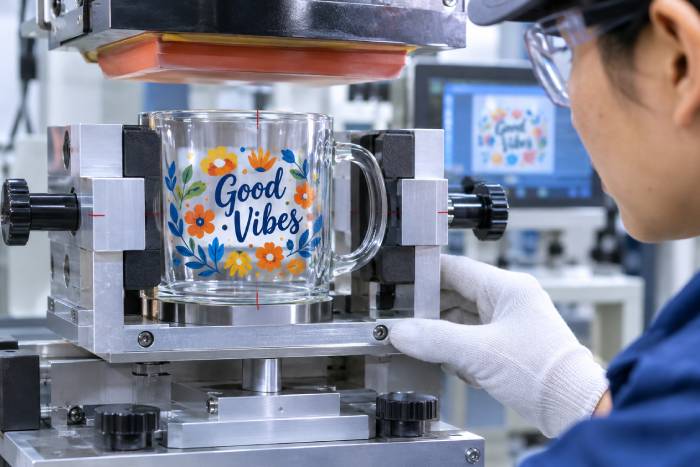
Heat transfer application: The transfer is applied using controlled temperature, pressure, and dwell time according to the material supplier’s specifications.
Curing and finishing: The decorated glass may require additional curing or finishing, depending on the transfer system.
Quality inspection: The finished product is checked for color accuracy, print alignment, surface defects, and adhesion.
The exact temperature, pressure, and processing time must be established through equipment trials and material compatibility testing rather than applying one universal setting to every glass cup.
Heat Transfer Printing on Glass Cups vs. Other Glass Printing Methods
Choosing the correct decoration method is one of the most important decisions when developing customized glass cups. Different technologies provide different results in terms of appearance, production cost, durability, and minimum order quantity.
Heat Transfer Printing vs. UV Printing on Glass
UV printing uses ultraviolet-curable inks that solidify under UV light. It is suitable for many customized designs and can support multicolor artwork, variable designs, and short production runs when the equipment and ink system are compatible with the glass surface.
Heat transfer methods can be advantageous when a suitable transfer system is available, particularly for specific coated surfaces and repeatable decorative designs.
However, untreated glass can present adhesion challenges for both processes. Surface treatment, ink chemistry, and testing are essential to achieving satisfactory results.
Heat Transfer Printing vs. Screen Printing on Glass
Screen printing transfers ink through a mesh screen and is commonly used for repeat designs and larger production quantities.
It can be an effective option for simple logos, solid colors, and designs requiring consistent placement across a production batch. Traditional glass screen-printing systems may use specialized inks and curing processes.
Heat transfer printing may offer greater flexibility for certain complex designs, depending on the transfer technology and production setup.
Heat Transfer Printing vs. Ceramic Printing on Glass
Ceramic printing uses specialized ceramic inks that are fired at high temperatures to bond the decoration to compatible glass substrates. It is commonly considered for applications requiring durable decoration.
The firing process, glass composition, thermal compatibility, and product specifications must be evaluated carefully.
For glass cups intended for repeated washing or food-contact applications, the suitability of the entire decoration system should be verified before production.
| Printing method | Design capability | Production suitability | Important consideration |
|---|---|---|---|
| Heat transfer printing | Depends on transfer material and coating | Suitable for compatible products and processes | Requires verified glass compatibility |
| UV printing | Multicolor graphics and detailed artwork | Short to medium runs, depending on equipment | Adhesion and abrasion resistance require testing |
| Screen printing | Strong results for selected colors and repeat designs | Often attractive for repeat production | Setup costs and color limitations |
| Ceramic printing | Specialized, durable glass decoration | Suitable for compatible industrial production | Requires appropriate firing and thermal control |
| Adhesive decals | Detailed graphics and specialty designs | Prototypes and selected production runs | Adhesive durability and appearance vary |
For businesses evaluating heat transfer printing on glass cups, the best solution should be selected according to the product’s intended use, artwork, production volume, and quality requirements.
Technical Specifications for Heat Transfer Printing on Glass Cups
Technical specifications help buyers communicate their requirements clearly and reduce the risk of production inconsistencies.
The following table provides indicative planning ranges for customized glass cup projects. These figures are examples for product development and quotation discussions, not verified specifications of a particular Hyuntech product. Final values depend on the selected glass model, decoration system, and supplier capabilities.
Glass Cup Printing Specifications
| Specification | Indicative planning range | Notes |
|---|---|---|
| Glass cup capacity | 200–500 ml | Depends on cup design |
| Glass material | Soda-lime glass or compatible glassware | Confirm the exact material |
| Common print area | Approximately 40–180 mm wide | Depends on cup geometry |
| Artwork resolution | 300 DPI at final print size | Suitable for many raster designs |
| Preferred artwork format | AI, EPS, PDF, SVG, PNG | Vector files are preferred for logos |
| Print colors | Single color to full color | Depends on printing technology |
| Sample development | Approximately 3–10 business days | Planning estimate, subject to complexity |
| Production lead time | Approximately 10–25 business days | Excludes shipping; subject to order details |
| Initial quality inspection | Visual inspection and adhesion checks | Additional tests may be required |
| Packaging | Individual protective packaging or bulk cartons | Depends on shipping and customer requirements |
Temperature, Pressure, and Transfer Time
Heat transfer parameters must be matched to the specific transfer paper, ink, coating, and glass cup. Applying excessive heat can create thermal stress or damage the product, while insufficient heat may result in incomplete transfer or poor adhesion.
The following table identifies the parameters that should be confirmed during production trials.
| Process parameter | What to verify | Recommended approach |
|---|---|---|
| Temperature | Compatibility with glass and transfer system | Follow supplier instructions and validate through trials |
| Pressure | Uniform contact across the intended print area | Adjust to the cup’s shape and equipment |
| Dwell time | Complete transfer without damaging the substrate | Establish through controlled testing |
| Surface coating | Compatibility with ink and transfer medium | Confirm before mass production |
| Cooling process | Stability of the decorated surface | Follow the specified finishing procedure |
| Adhesion | Resistance to handling and intended washing conditions | Conduct documented performance tests |
Glass can break when exposed to inappropriate thermal changes. Production trials should therefore use suitable equipment, trained operators, and controlled temperature changes.
Heat Transfer Printing on Glass Cups: Price Guide
The cost of custom glass cup printing depends on glass quality, order quantity, print dimensions, number of colors, decoration method, packaging, sample development, and shipping destination.
For budget planning, the following figures are illustrative market-planning estimates in US dollars, not confirmed Hyuntech quotations or verified current supplier prices.
Estimated Custom Glass Cup Printing Prices
| Order quantity | Indicative unit price | Estimated product subtotal |
|---|---|---|
| 100–299 cups | US$2.50–5.00 | US$250–1,495 |
| 300–999 cups | US$1.80–4.00 | US$540–3,996 |
| 1,000–2,999 cups | US$1.20–3.20 | US$1,200–9,597 |
| 3,000–4,999 cups | US$0.90–2.60 | US$2,700–12,997 |
| 5,000 cups or more | US$0.70–2.20 | From US$3,500, depending on quantity |
These ranges are intended for preliminary budgeting only. They do not represent confirmed supplier offers and may not apply to premium glassware, complex decoration, specialized coatings, or particular production markets.
The final price should be confirmed after the glass model, artwork, printing method, quantity, packaging, and delivery terms are specified.
What Factors Affect Glass Cup Printing Costs?
Glass cup material and shape: Standard cylindrical cups may be easier to decorate than curved, textured, or unusually shaped glassware.
Printing technology: UV printing, screen printing, ceramic decoration, and heat transfer systems have different equipment, setup, and consumable costs.
Artwork complexity: Detailed graphics, multiple colors, special effects, and large print areas may increase production costs.
Order quantity: Larger orders may reduce the allocated setup cost per unit, depending on the production method.
Packaging and transportation: Individual gift boxes, protective inserts, export cartons, and international freight can substantially affect the total landed cost.
Sampling and testing: Prototype development, adhesion testing, and special compliance requirements may involve additional charges.
How to Request an Accurate Quotation from Hyuntech
To obtain a useful quotation for heat transfer printing on glass cups, prepare the following information:
- Glass cup capacity and product reference.
- Required order quantity.
- Logo or artwork file.
- Desired print area and number of colors.
- Intended application, such as promotional gifts or retail sales.
- Packaging and labeling requirements.
- Destination country and preferred delivery date.
- Washing, abrasion, and food-contact requirements, where applicable.
Providing these details helps Hyuntech evaluate the project and determine the appropriate decoration solution.
Applications of Heat Transfer Printing on Glass Cups
Customized glass cups are used across a wide range of commercial and promotional applications.
Corporate Gifts and Promotional Merchandise
Branded glass cups are suitable for company events, exhibitions, customer appreciation campaigns, employee gifts, and promotional packages.
A well-positioned company logo can reinforce brand recognition while providing recipients with a practical everyday product.
Retail and E-commerce Products
Retail brands can develop custom drinkware featuring original artwork, seasonal graphics, product slogans, or licensed designs, subject to the appropriate intellectual property permissions.
Consistent decoration and reliable packaging are important for maintaining product presentation across online and offline sales channels.
Cafés, Restaurants, and Hospitality Businesses
Restaurants, hotels, cafés, and beverage businesses can use branded glassware to strengthen their visual identity.
For these applications, buyers should confirm resistance to repeated washing, compatibility with the intended cleaning process, and suitability for commercial food-service environments.
Events, Weddings, and Personalized Gifts
Custom glass cups can be designed for weddings, birthdays, festivals, company anniversaries, and other special occasions.
Personalized names, dates, messages, and illustrations can create distinctive products for gifting and event merchandising.
How to Choose a Reliable Glass Cup Printing Manufacturer
Selecting a supplier involves more than comparing the lowest quoted price. Businesses should evaluate technical capabilities, product quality, communication, production consistency, and the supplier’s ability to meet project requirements.
Evaluate Printing Quality and Material Compatibility
Ask the manufacturer to confirm whether the proposed transfer process is suitable for the selected glass. Request physical samples where possible, particularly when color accuracy, fine details, or repeated washing performance are important.
A professional supplier should explain the limitations of the selected method rather than promising identical results across all glass types.
Confirm Quality Control Procedures
Important quality checks include:
- Glass surface inspection before printing.
- Artwork placement and color verification.
- Adhesion and abrasion testing appropriate to the application.
- Inspection for scratches, bubbles, cracks, and decoration defects.
- Packaging checks to reduce damage during transportation.
For products intended for repeated washing, the buyer should request evidence that the decorated product has been tested under the intended washing conditions.
Review Production Capacity and Delivery Requirements
Before placing a bulk order, clarify sample approval procedures, production lead times, inspection arrangements, packaging specifications, and shipping terms.
The manufacturer should also confirm how changes to artwork or product specifications affect the quotation and delivery schedule.
Why Consider Hyuntech for Custom Glass Cup Printing?
Hyuntech can be approached for customized glassware projects that require product development, decoration planning, and coordination of production requirements.
For buyers considering heat transfer printing on glass cups, the most important step is to confirm the availability of the required glass model and verify that the proposed printing technology is suitable for the product.
Customization for Different Business Requirements
A glass cup project may require a simple logo, full-color artwork, customized packaging, or coordinated product designs for a promotional campaign.
Hyuntech can be contacted to discuss the specific requirements and determine which services and production options are available for the project.
Support for OEM and ODM Projects
Businesses developing their own drinkware products should communicate their branding, design, packaging, and target market requirements clearly.
OEM and ODM arrangements, including custom product development and branded packaging, should be confirmed directly with Hyuntech based on the project scope and manufacturing capabilities.
Quality and Production Planning
Before approving mass production, buyers should establish the acceptance criteria for appearance, print placement, color, adhesion, packaging, and delivery.
Hyuntech should be asked to confirm the available testing procedures, sample approval process, production capacity, and any relevant product documentation.
These steps help both parties align expectations and reduce avoidable production issues.
Start Your Custom Glass Cup Printing Project with Hyuntech
Looking for a supplier for heat transfer printing on glass cups for your brand, retail business, or promotional campaign?
Contact Hyuntech to discuss your glass cup specifications, artwork, order quantity, packaging preferences, and intended application. The appropriate printing process and final quotation can then be evaluated according to your project requirements.
For a faster quotation, prepare your logo file, target quantity, preferred cup capacity, print dimensions, and delivery destination before contacting the company.
Request a quotation from Hyuntech and discuss the right customization solution for your glass cup project.
Frequently Asked Questions About Heat Transfer Printing on Glass Cups
Can you use heat transfer printing on glass cups?
Yes, certain heat transfer systems can be used on glass cups when the transfer material, ink, coating, and glass surface are compatible. Untreated glass is not suitable for every transfer process, so testing is recommended before mass production.
Is heat transfer printing on glass cups durable?
Durability depends on the printing system, surface preparation, curing conditions, and intended use. Buyers should request adhesion and abrasion testing and, when necessary, washing tests under the expected conditions.
How much does heat transfer printing on glass cups cost?
The price varies according to glass type, order quantity, print complexity, packaging, and shipping. Illustrative planning estimates may range from approximately US$0.70 to US$5.00 per cup, but the actual price must be confirmed with the supplier.
What file format should I provide for custom glass cup printing?
AI, EPS, SVG, and print-ready PDF files are preferred for logos and vector artwork. High-resolution PNG files may also be suitable for certain designs. The final file requirements depend on the printing method.
How can I order custom glass cups from Hyuntech?
Prepare your product specifications, artwork, quantity, print requirements, packaging preferences, and delivery destination, then contact Hyuntech to confirm available products, printing compatibility, production lead time, and quotation terms.
Bài viết cùng chủ đề
-
 Heat Transfer Printing Process Explained (Step-by-Step)
-
 High-End Packaging Printing for Luxury Product Brands
-
 Heat Transfer Film for Plastic Packaging: Applications & Benefits
-
 Packaging Solutions for Global Brands: Standards & Innovation
-
 Top Benefits of Heat Transfer Film in Plastic Packaging Industry
-
 Heat Transfer Film Applications in Plastic Packaging Industry